Condition Guide
Back Pain Chiropractor in Carlsbad: What Actually Works
Low back pain is the most common reason Carlsbad patients book chiropractic care. Here is what causes it, which treatments hold up, how long relief realistically takes, and when back pain needs medical evaluation instead.
Pacific Spine & Rehab Clinical Team, DC, Chiropractic & Rehab Published August 26, 2026 Updated August 26, 2026 12 min read
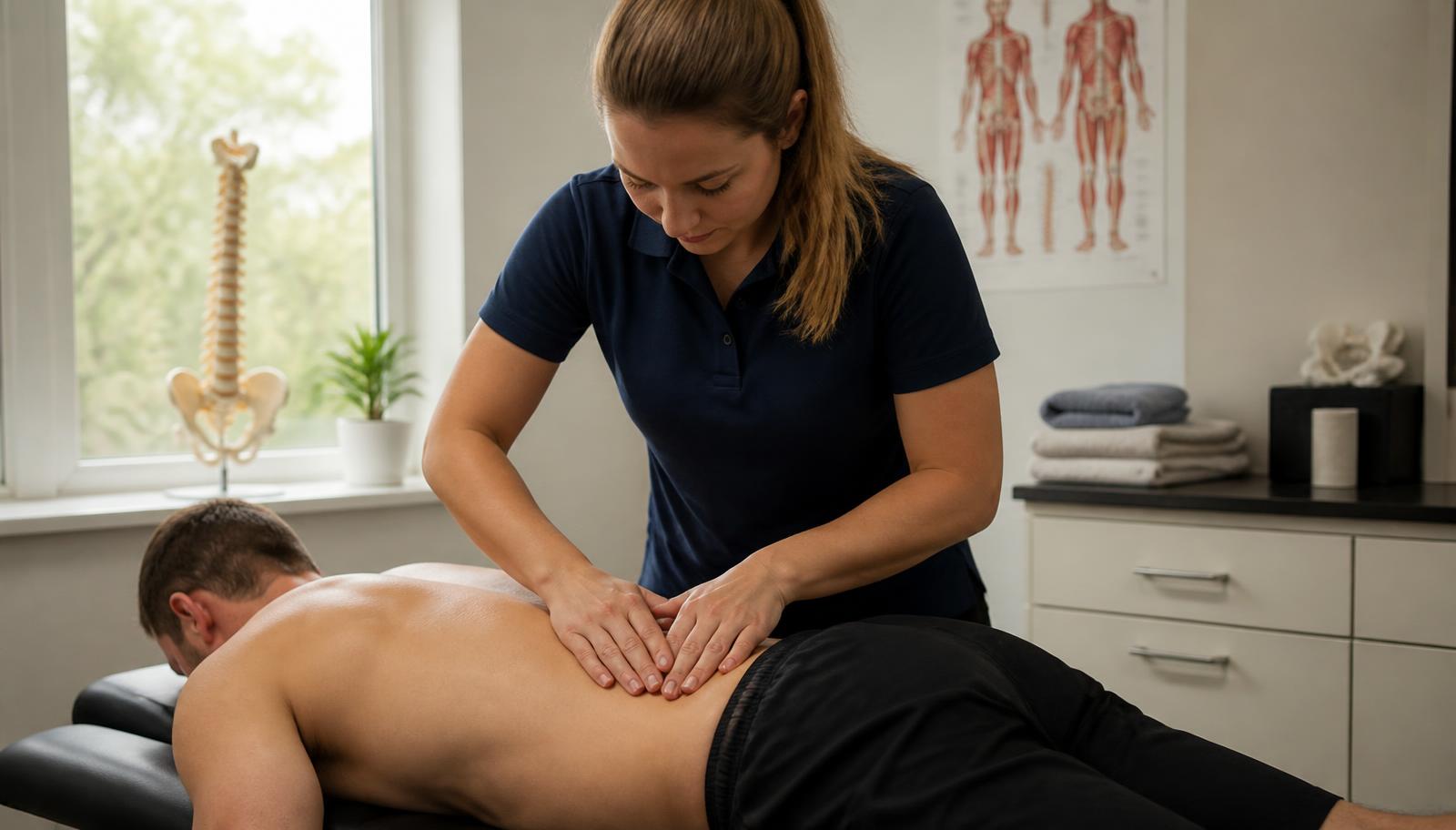
Low back pain is the single most common reason people book with a back pain chiropractor in Carlsbad. It shows up after yard work, after a long drive down the 5, after a week of desk hours, or for no obvious reason at all — you bend to pick up a shoe and something locks. Our Carlsbad (Bressi Ranch) office treats this every day, and the pattern behind it is usually more ordinary than people fear.
This guide explains what is actually generating the pain, which treatments have evidence behind them, how quickly relief tends to arrive, what care costs locally, and the specific symptoms that mean you should see a physician instead of a chiropractor.
Quick answer
A back pain chiropractor in Carlsbad treats low back pain with spinal adjustments, soft-tissue therapy, decompression, and rehab exercise. Most patients feel meaningful relief within two to four visits, and lasting correction usually takes four to eight weeks of combined hands-on care and strengthening.
Key takeaways
- Most low back pain is mechanical — joint restriction plus weak support muscles — not disc damage.
- Relief usually starts in 2–4 visits; lasting change takes 4–8 weeks with rehab included.
- Adjustments alone rarely hold. Strengthening is what prevents the next flare.
- Imaging is not needed for most cases in the first six weeks unless red flags are present.
- New-patient exams in Carlsbad run about $49–$75; most health plans cover ongoing visits.
What is causing your low back pain?
In the large majority of cases, low back pain is mechanical. A joint in the lumbar spine or pelvis loses normal motion, the muscles around it tighten to protect it, and that guarding becomes its own source of pain. Nothing is torn and nothing is crumbling — the region is simply not moving the way it should.
The National Institute of Neurological Disorders and Stroke notes that most low back pain is acute, mechanical in origin, and improves with conservative care rather than surgery. That matches what walks through the door: strain, joint restriction, and deconditioning far outnumber serious pathology.
Disc problems are real but less common than the internet suggests. A bulging or herniated disc typically produces pain that travels below the knee, along with numbness or tingling. Pain that stays in the belt line, worsens with certain movements, and eases with position changes is usually joint and muscle driven.
| Symptom pattern | What it may mean | Recommended next step |
|---|---|---|
| Pain across the belt line, worse bending | Lumbar joint restriction and muscle guarding | Chiropractic exam and adjustment |
| Pain radiating below the knee with tingling | Disc irritation or nerve involvement | Exam with neurological testing, possible decompression |
| One-sided pain near the hip dimple | Sacroiliac joint dysfunction | Targeted adjustment plus glute strengthening |
| Stiffness worst in the morning, eases with movement | Joint stiffness and deconditioning | Mobility work and graded exercise |
| Pain after a car accident or fall | Soft-tissue strain, possible ligament injury | Prompt exam and documented treatment |
| Constant pain at rest with weight loss or fever | Possible non-mechanical cause | Medical evaluation first |
Common signs it is more than ordinary soreness
Recurrence is the signal most people ignore. A back that "goes out" twice a year is not unlucky — it is under-supported. That pattern responds well to rehab therapy for recurring back pain, which is where lasting change comes from.
- Pain lasting longer than a week without steady improvement.
- The same episode returning every few weeks or months.
- Difficulty standing straight after sitting, or pain putting on socks.
- Numbness, tingling, or weakness running into the buttock or leg.
- Pain that wakes you at night or forces frequent position changes.
- Back pain that started after a collision, fall, or heavy lift at work.
Causes and risk factors in Carlsbad
Local caseloads reflect local life. Business-park desk work produces long static sitting and weak hip extensors. Surfing, golf, and trail running produce rotational strain. Commuting on the 78 and I-5 produces both prolonged sitting and rear-end collision injuries.
Lifting is the other major driver. The National Institute for Occupational Safety and Health identifies repetitive lifting, awkward postures, and prolonged static positions as leading contributors to work-related back injury — the same three histories that appear in most intake forms.
- Sitting more than six hours a day with few movement breaks.
- A sudden jump in training volume after time off.
- A previous episode that was never rehabilitated past pain relief.
- Weak gluteal and deep core muscles, which shifts load onto the lumbar joints.
- Poor sleep and high stress, which raise muscle guarding and pain sensitivity.
Important things to know before treatment
Three points save patients time, money, and unnecessary worry.
- Imaging is usually unnecessary early. For uncomplicated back pain without red flags, X-rays and MRI in the first six weeks rarely change the treatment plan.
- Rest is not the treatment. Extended bed rest slows recovery. Controlled movement, guided early, works better.
- Relief and correction are different. An adjustment can settle pain quickly; keeping it away requires strengthening the muscles that failed in the first place.
Findings on a scan are not always the cause
Disc bulges and degenerative changes appear on imaging in plenty of people with no pain at all. The exam findings — what hurts, what moves, what tests positive — matter more than the picture.
Treatment options a back pain chiropractor uses
A clinic with one tool will use it for everything. Back pain responds better to a combination matched to the exam findings.
- More detail on chiropractic care for back pain and on lower back pain treatment.
| Treatment | Best for | Expected outcome |
|---|---|---|
| Spinal adjustment | Joint restriction, acute locked back | Restored motion, fast pain relief |
| Soft-tissue therapy | Muscle guarding and spasm | Reduced tension between visits |
| Spinal decompression | Disc bulge, sciatica, leg symptoms | Less nerve pressure over 4–8 weeks |
| Rehab and corrective exercise | Recurring pain, weak core and glutes | Fewer relapses, durable correction |
| Shockwave therapy | Chronic tendon and attachment pain | Tissue healing across 4–6 sessions |
| Home program | Everyone | Maintains gains between appointments |
How long relief actually takes
The checkpoint matters more than the count. If nothing measurable has changed by visit six — pain level, range of motion, or function — the plan should be revised or you should be referred for further evaluation.
| Situation | First noticeable relief | Typical full plan |
|---|---|---|
| Acute strain, first episode | 1–3 visits | 4–8 visits over 3–4 weeks |
| Recurring back pain | 2–4 visits | 12–20 visits over 8–12 weeks |
| Disc-related pain with leg symptoms | 2–5 visits | 8–12 weeks including decompression |
| Post-accident back injury | 2–4 visits | 8–16 weeks, documented for the claim |
Cost and insurance for back pain care in Carlsbad
New patients without coverage can start with the $49 new patient exam and first treatment, which includes the full evaluation.
| Situation | What you pay | Notes |
|---|---|---|
| New patient exam, self-pay | $49–$75 | Our new-patient special is $49 including first treatment |
| Follow-up visit, self-pay | $45–$75 | Lower with a prepaid package |
| With health insurance | Standard copay | Benefits verified before billing |
| Car accident injury | $0 up front | Treated on a lien, paid from the settlement |
| Work injury | $0 up front | Billed through workers' compensation |
When should you seek professional help immediately?
Most back pain is safe to treat conservatively. A short list of symptoms is not, and those need urgent medical evaluation rather than a chiropractic appointment.
- Loss of bladder or bowel control, or numbness around the groin and inner thighs.
- Progressive weakness in a leg rather than pain alone.
- Unexplained weight loss or fever alongside back pain.
- Severe pain following a high-speed collision or significant fall.
- A history of cancer, osteoporosis, or recent spinal surgery with new back pain.
Booking with a back pain chiropractor in Carlsbad
- Call or book online — same-day openings are held for acute back pain.
- Bring your insurance card and any imaging or accident paperwork.
- Plan on about 45 minutes for the first visit.
- Expect an exam and an explanation before any treatment.
- Leave with a written plan, a review date, and a short home program.
Frequently asked questions
Can a chiropractor fix lower back pain?
For mechanical low back pain, yes — chiropractic care is one of the better-supported conservative options. Adjustments restore motion to restricted lumbar and pelvic joints, soft-tissue work releases the muscle guarding that follows, and rehab exercise rebuilds the support that failed. Most Carlsbad patients feel meaningful relief within two to four visits. What a chiropractor cannot fix is back pain from infection, fracture, tumor, or progressive nerve compression; a thorough exam screens for those and refers out when the findings call for it rather than treating anyway.
How much does a back pain chiropractor cost in Carlsbad?
A new-patient exam with treatment generally runs $49 to $75 locally when paying out of pocket, and our new-patient special is $49 for the exam, consultation, and first treatment. Ongoing self-pay visits usually fall between $45 and $75, less with a prepaid package. With health insurance, most major plans include chiropractic benefits and you pay your standard copay; we verify coverage before billing. Car-accident injuries are treated on a lien with nothing due up front, and work injuries are billed through workers' compensation.
How many chiropractic visits will I need for back pain?
A first-time acute strain often resolves in four to eight visits across three to four weeks. Recurring back pain typically takes twelve to twenty visits over eight to twelve weeks, because the strengthening phase matters as much as the hands-on work. Disc-related pain with leg symptoms usually runs eight to twelve weeks and may include spinal decompression. Post-accident injuries commonly take eight to sixteen weeks with documentation for the claim. Regardless of the number, the plan should include a review point around visit six.
Do I need an MRI for back pain?
Usually not right away. For uncomplicated low back pain without red flags, imaging in the first six weeks rarely changes treatment, and scans frequently show disc bulges or degenerative changes in people who have no pain at all. Imaging becomes appropriate when there are red flags — progressive weakness, bladder or bowel changes, significant trauma, unexplained weight loss, fever, or a cancer history — or when conservative care has not produced meaningful change over several weeks. A proper exam determines which category you fall into.
Is it better to rest or move with back pain?
Controlled movement beats rest for most low back pain. Prolonged bed rest weakens supporting muscles, stiffens joints, and tends to lengthen recovery. In the first day or two, avoid the specific movements that sharply aggravate the pain, but keep walking and changing position regularly. From there, guided exercise progressing from gentle mobility to strengthening produces the best long-term outcome. The exception is pain following significant trauma or accompanied by neurological red flags, which needs evaluation before any exercise program starts.
Can chiropractic care help sciatica and disc pain?
Often, yes. Sciatica describes nerve irritation producing pain, numbness, or tingling down the leg, commonly from a disc bulge or a restricted joint pressing on the nerve pathway. Chiropractic care addresses this with careful adjustment, soft-tissue work, and frequently spinal decompression, which reduces pressure inside the disc over a series of sessions. Improvement is usually gradual across four to eight weeks rather than immediate. Progressive leg weakness or loss of bladder or bowel control is a different situation and requires urgent medical evaluation.
Can I get same-day treatment for a locked back in Carlsbad?
Yes. We hold same-day openings at the Carlsbad office each day specifically for acute back pain, spasm, and flare-ups. Same-day care matters here because the earlier the guarding phase is interrupted, the shorter the whole episode tends to be — waiting three days with a locked back usually means a longer recovery. Call in the morning for the widest choice of times, and bring your insurance card. If your symptoms suggest something outside chiropractic scope, we will tell you directly and refer you.
Same-day appointments
Talk to a doctor about your case
Get an exam, a diagnosis, and a written plan — two North County offices, treatment on lien for injury cases.
PS
Medically reviewed by
Pacific Spine & Rehab Clinical Team, DC, Chiropractic & Rehab
The Pacific Spine & Rehab clinical team practices in Oceanside and Carlsbad (Bressi Ranch). Our doctors of chiropractic combine manual care, spinal decompression, shockwave therapy, and rehab in one treatment plan — and treat auto-accident and injury patients on lien.
Related services
Related conditions
Related articles