Shockwave first visit
$75
- Consultation
- Exam
- First shockwave therapy treatment
Plantar fasciitis is the heel pain that won't quit. Here is exactly how extracorporeal shockwave therapy treats it, what the research shows, and how patients respond at our Oceanside and Carlsbad offices.
Short answer: yes — for the right patient. Extracorporeal shockwave therapy (ESWT) is one of the most studied non-surgical options for chronic plantar fasciitis, and it consistently helps people who have not responded to stretching, orthotics, or cortisone.
This guide explains how shockwave works, what a session feels like, how many treatments most heels need, and the cases where we recommend something different. If you have been limping for more than three months, this is written for you.
Ready to get checked? See our shockwave therapy in Oceanside page or the new patient special offers.
Quick answer
Yes, for the right patient. Shockwave therapy sends acoustic pulses into the degenerated plantar fascia to restart healing. Most patients need 4 to 6 weekly sessions of 10 to 15 minutes, with no downtime. Many notice less morning pain after 2 or 3 sessions, and the largest benefit usually arrives at 8 to 12 weeks.
Key takeaways
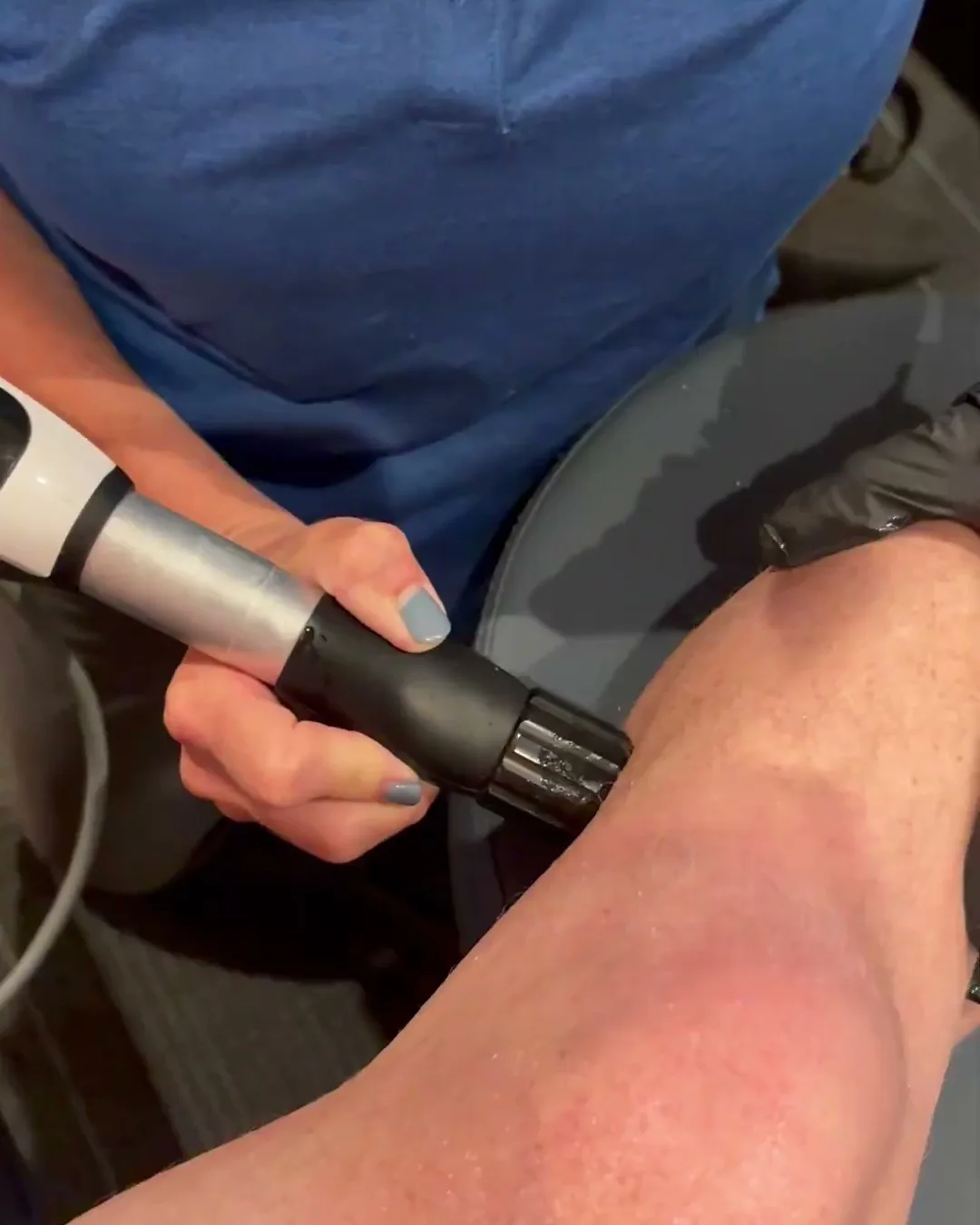
Shockwave therapy uses pulses of acoustic (sound) energy delivered through a handheld applicator into the painful tissue. The pulses are mechanical, not electrical, and they pass through skin to reach the plantar fascia at the bottom of your foot.
Shockwave first visit
$75
Chiropractic first visit
$49
New patients only. Same-day first treatment when appropriate. Personal injury and auto accident claims are billed on lien instead. Available at both offices. See details
Those pulses create a controlled micro-injury in chronically inflamed or degenerated tissue. That micro-injury restarts the body's own healing cascade — new blood vessels form, collagen is laid down, and nerve sensitivity is reset. It is one of the few treatments that targets the underlying tissue problem rather than masking the pain signal.
Plantar fasciitis is rarely an acute injury. By the time most patients arrive at our office, the plantar fascia has been overloaded for months — the tissue is no longer simply inflamed, it is degenerated. That is why stretching and ice often stop working after the first few weeks.
Shockwave bypasses that stalled-out healing process. The acoustic pulses are aimed at the medial calcaneal tubercle (the inside-front of the heel bone) where the plantar fascia attaches and where most heel pain originates. The mechanical stimulus tells the body, in effect, that this is fresh tissue damage worth healing.
Why shockwave succeeds where injections fail
Cortisone shots reduce inflammation for a few weeks but do not rebuild the fascia — and repeated injections weaken the tissue. Shockwave does the opposite: it triggers true tissue remodeling, so the benefit holds.
Shockwave therapy for chronic plantar fasciitis is endorsed by the American College of Foot and Ankle Surgeons and is FDA-cleared in the United States. Multiple randomized trials and a 2023 Cochrane review found clinically meaningful pain reduction at 12 weeks compared with sham treatment, with effects holding at six and twelve months.
Reported success rates range from roughly 65% to 88% in patients with symptoms longer than six months. The therapy works best when conservative care has already been tried — which matches what we see clinically.
For a plain language overview of plantar fasciitis and its standard treatments, see the National Library of Medicine (MedlinePlus).
Each session lasts about ten to fifteen minutes. You lie face down with your foot exposed. We map out the painful trigger point by palpation, apply a thin layer of ultrasound gel, then deliver between 2,000 and 3,000 pulses through the applicator.
The sensation is firm, tapping pressure — most patients describe it as intense but tolerable. We adjust energy levels in real time based on your feedback. There is no anesthesia, no needles, and you walk out of the office.
Plantar fasciitis did not start overnight, and shockwave does not fix it overnight either. The micro-healing response builds over weeks, not days.
Honest expectation
Roughly 1 in 5 patients needs a second short course of shockwave 3–6 months later. We monitor and tell you early if you are responding slower than expected so we can add rehab or a custom orthotic.
Shockwave is non-invasive but it is not appropriate for everyone. We screen for the following before recommending it.
Most patients we see have already tried one or two things. Here is how shockwave compares.
| Treatment | How it compares |
|---|---|
| Stretching and orthotics | Helpful early, insufficient once the fascia has degenerated |
| Cortisone injection | Fast short-term relief, no tissue healing, weakens fascia if repeated |
| Night splints | Reduce morning pain for some, tolerance is mixed |
| Platelet-rich plasma (PRP) | Similar healing mechanism, requires a needle, more expensive |
| Plantar fascia release surgery | Last resort with a long recovery, rarely needed when shockwave is used first |
We rarely use shockwave on its own. The fastest, most durable results come from pairing it with rehab so the foot mechanics that caused the problem actually change.
Shockwave is available at both offices. Book with our chiropractor in Oceanside or chiropractor in Carlsbad, and read more about shockwave therapy, rehab therapy, plantar fasciitis, and sports injuries.
A typical plan looks like this:
Most patients need 4 to 6 weekly sessions. Mild cases can resolve in 3; long-standing cases may need a second short course 3–6 months later. Many patients notice less morning pain after 2–3 sessions. The largest benefit is typically at 8–12 weeks as tissue remodeling completes.
It is intense but tolerable — most patients rate it 4–6 out of 10 during the actual pulses. We adjust energy in real time. There is no anesthesia required and no recovery time.
We do not participate with most health plans, and shockwave therapy is offered at transparent flat-rate pricing. Auto-accident and injury cases can be treated on lien.
Yes — usually with light modification. We will give you specific guidance based on your pain levels and how you respond to the first session.
Radial shockwave spreads energy across a wider area and is what most plantar fasciitis protocols use. Focused shockwave penetrates deeper and is used for select cases. We use the right modality for your case.
Same-day appointments
Get an exam, a diagnosis, and a written plan — two North County offices, treatment on lien for injury cases.
Written by
Dr. Peter Thompson, DC
Doctor of Chiropractic
Dr. Peter Thompson is a doctor of chiropractic at Pacific Spine & Rehab, which has offices in Oceanside and Carlsbad (Bressi Ranch). He writes about back and neck pain, sports injuries, shockwave therapy, and recovery after auto accidents.