Chiropractic first visit
$49
- Consultation
- Full exam and movement screen
- First chiropractic treatment
TMJ pain is rarely just a jaw problem. Here is how chiropractic care addresses the cervical spine and jaw together, what the research says, and what realistic results look like at our Oceanside and Carlsbad offices.
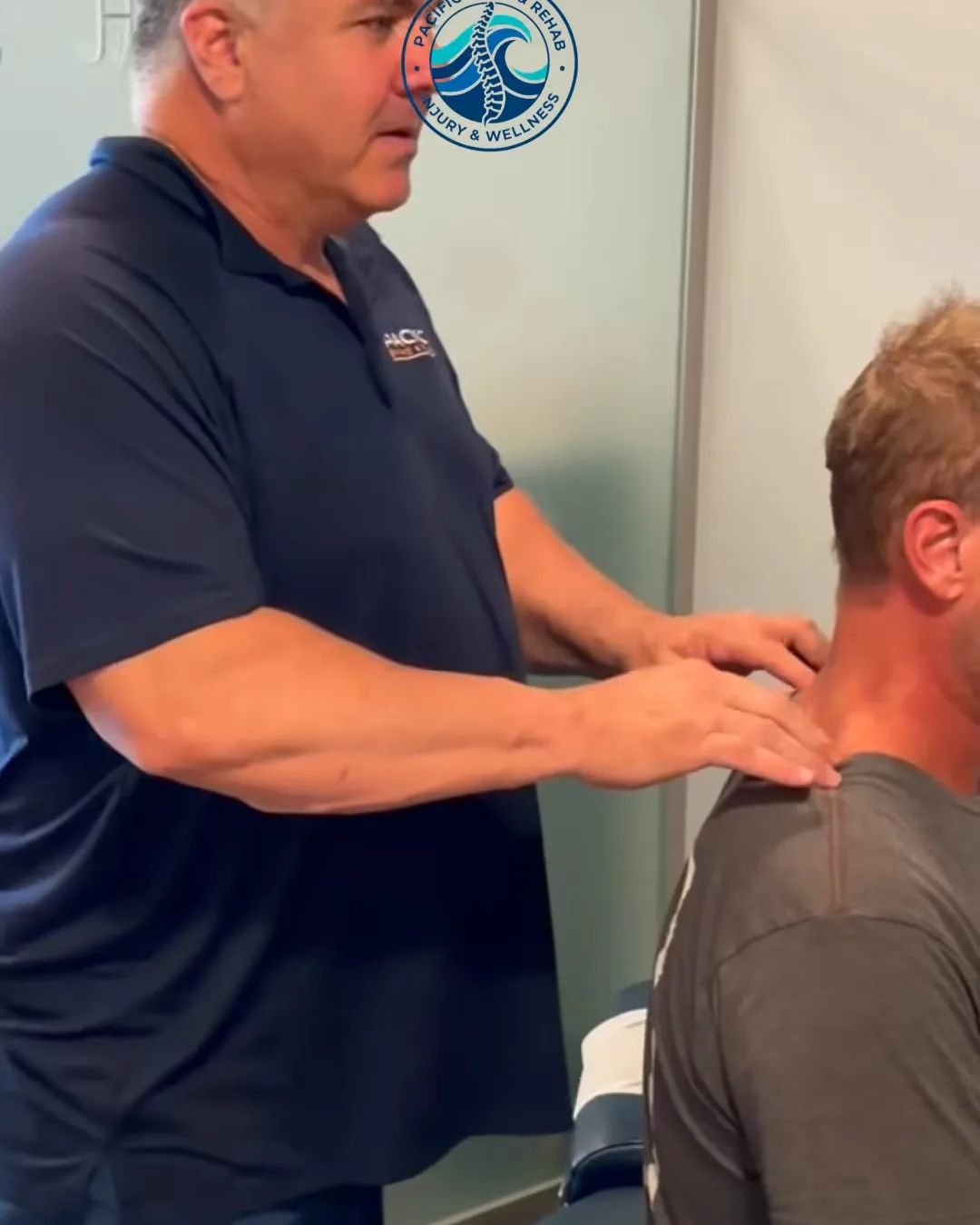
Yes — chiropractic care can meaningfully reduce TMJ and jaw pain, especially when the temporomandibular joint problem is driven by the upper neck, posture, or muscle tension (which is most of the time).
This article explains why the jaw and the upper cervical spine work as one unit, what a TMJ-focused chiropractic appointment actually looks like, who benefits most, and when we refer to a TMJ-trained dentist instead.
Ready to get checked? See our chiropractor in Oceanside page or the new patient special offers.
Quick answer
Yes, chiropractic care can reduce TMJ and jaw pain when the upper neck, posture, or muscle tension is driving it. Care combines gentle upper neck mobilization, jaw muscle release, and posture work. Most patients see meaningful change in 3 to 6 sessions. If you are not better by session 6, we coordinate with a TMJ-trained dentist.
Key takeaways
The temporomandibular joint (TMJ) is one of the most-used joints in the body — it moves every time you talk, chew, swallow, or yawn. It does not sit in isolation. The TMJ shares a neurological wiring diagram with the upper three cervical vertebrae (C0–C3) through the trigeminocervical nucleus in the brainstem.
Chiropractic first visit
$49
Shockwave first visit
$75
New patients only. Same-day first treatment when appropriate. Personal injury and auto accident claims are billed on lien instead. Available at both offices. See details
Practically, that means a stiff, forward-jutting upper neck can drive jaw pain — and a clenched, tight jaw can drive headaches and neck stiffness. Treating one without the other usually fails. This is why TMJ patients often bounce between a dentist's night guard and other passive treatments with no lasting relief.
Common pattern we see
Office worker, head forward over a screen, chronic upper neck tension, then a clicking jaw and morning headaches. The night guard helps the teeth — but the upper neck is still feeding the jaw.
TMJ-focused chiropractic care has three goals: restore mobility to the upper cervical spine, release the muscles that move and stabilize the jaw, and reduce the protective tension pattern feeding the pain.
We do this with a combination of gentle joint mobilization, soft-tissue work (intra- and extra-oral), and posture correction. None of it requires a high-velocity neck adjustment unless that is clinically appropriate and the patient is comfortable with it.
Multiple systematic reviews — including a 2022 review in the Journal of Bodywork and Movement Therapies — found that manual therapy and exercise targeting both the cervical spine and the jaw produced clinically meaningful reductions in TMJ pain and improvements in mouth opening compared with sham or no treatment.
The strongest evidence supports a combined approach: cervical mobilization + jaw-specific soft-tissue and exercise. That mirrors what we do clinically.
For background on TMJ disorders, symptoms, and conservative care, see the National Institute of Dental and Craniofacial Research (NIH).
Chiropractic care is excellent for musculoskeletal TMJ — the muscle, joint, and posture drivers. It will not fix every TMJ presentation. We refer out for:
Our rule
If a patient is not meaningfully better in 6–8 sessions, we don't keep going. We coordinate with a TMJ-trained dentist or oral-medicine specialist.
The first visit is mostly diagnostic. We measure your mouth opening, palpate the TMJ during movement, screen the upper cervical spine, and check posture and breathing patterns. We also rule out red flags (ear pathology, dental abscess, tumor, recent trauma).
Treatment visits run 25–40 minutes. We work the upper neck and jaw muscles together — much of the soft-tissue work for the lateral pterygoid is done with a gloved finger from inside the mouth, which patients are sometimes surprised by but which is the most direct way to release the muscle responsible for jaw deviation.
| Sessions | What typically changes |
|---|---|
| 1 to 2 | Clearer picture of the drivers, first reduction in baseline tightness |
| 3 to 6 | Clicking often quiets, mouth opening improves, morning soreness decreases |
| 6 to 10 | Consolidation and tapering. Most patients return as needed (every 1 to 3 months) rather than weekly |
Our TMJ plan integrates chiropractic, soft-tissue work, and rehab. We coordinate care with your dentist when a night guard or occlusal evaluation is appropriate, and we will say so early when surgery or specialty referral is the right path. The goal is not endless visits — it is to get you out of pain and back to chewing, sleeping, and talking without thinking about your jaw.
TMJ care is available with our chiropractor in Oceanside and our chiropractor in Carlsbad. Learn more about chiropractic care, corrective exercise, TMJ and jaw pain, and headaches and migraines.
Yes — gentle mobilization of the TMJ is part of TMJ-focused chiropractic care. It is not a high-velocity thrust like some spinal adjustments. Most of the relief, though, comes from treating the upper neck and jaw muscles together. When performed by a trained chiropractor after a proper exam, yes. We screen for red flags including dental infection, recent jaw trauma, severe arthritis, and ear pathology before any hands-on work.
Most patients see meaningful change in 3–6 sessions and full benefit in 6–10. We re-evaluate at session 6; if you are not improving, we adjust the plan or coordinate with a TMJ-trained dentist.
Not necessarily — and we do not want it to. A well-fitted night guard protects your teeth from grinding. Chiropractic care addresses why the muscles are clenching in the first place. The two work well together.
Clicking is usually the disc inside the TMJ snapping in and out of position during movement. Chiropractic care can quiet many clicks by improving jaw mechanics and reducing muscle imbalance. Some structural clicks remain and are harmless if pain-free.
We do not participate with most health plans, so TMJ care is self-pay with transparent flat-rate pricing and a $49 New Patient Special. Auto-accident-related TMJ cases are treated on lien.
Same-day appointments
Get an exam, a diagnosis, and a written plan — two North County offices, treatment on lien for injury cases.
Written by
Dr. Peter Thompson, DC
Doctor of Chiropractic
Dr. Peter Thompson is a doctor of chiropractic at Pacific Spine & Rehab, which has offices in Oceanside and Carlsbad (Bressi Ranch). He writes about back and neck pain, sports injuries, shockwave therapy, and recovery after auto accidents.