
Non-surgical spinal decompression for disc-related back and neck pain
Spinal decompression is a computer-controlled, non-surgical traction therapy that creates negative pressure inside the spinal discs to relieve nerve compression and let dehydrated discs rehydrate and heal.
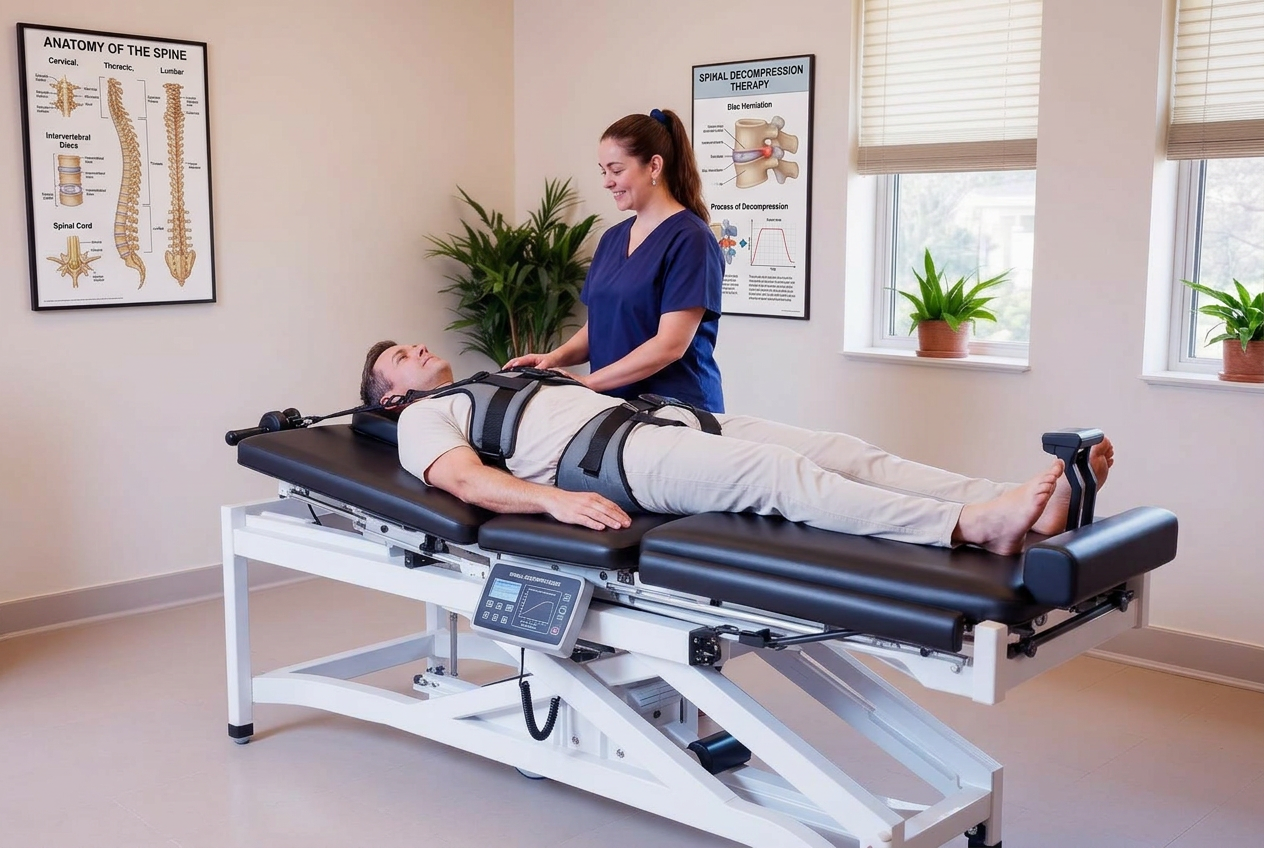
If imaging has shown a herniated, bulging, or degenerated disc and you have been told the next step is injections or surgery, spinal decompression is the conservative option worth trying first.
Unlike basic traction, modern decompression uses a computer to apply and release tension in a precise rhythm. Done correctly, this creates negative pressure inside the disc — and that negative pressure is what allows herniated material to retract and dehydrated discs to draw in fluid and nutrients.
Our protocol is short, comfortable, and built around your specific imaging findings. Most patients run 15–25 sessions over six to ten weeks, paired with rehab so the spine you decompress stays healthy.
What spinal decompression actually does
Spinal discs are pressurized cushions between the vertebrae. When a disc bulges, herniates, or degenerates, it loses height, the inner gel can press into the spinal nerves, and surrounding structures take on load they were not built for. That is what produces the radiating leg or arm pain people associate with sciatica and pinched nerves.
Decompression therapy uses a motorized table that gently elongates the spine in a specific direction and angle, then releases — over and over for 20 minutes. The cyclic stretch lowers pressure inside the targeted disc to roughly negative 100 mmHg, which is enough to draw retracted disc material away from the nerve and pull in fluid that rehydrates the disc.
The treatment is computer-controlled, painless, and entirely non-surgical. You stay fully clothed, lying face up on the table, with adjustable harnesses securing the pelvis and trunk.
How decompression relieves disc pressure
The science is straightforward. A disc that is herniated or compressed cannot heal because it is constantly being loaded by the weight of your body and the muscles guarding around it. The disc needs both decompression and improved fluid exchange to recover.
Cyclic decompression solves both. Negative intradiscal pressure mechanically pulls displaced material back toward center, while the rhythmic stretch and release acts like a pump that moves nutrients and water into a tissue that has very little blood supply of its own.
Step 1
Imaging review and disc-level targeting
We review your MRI or CT findings and identify the specific spinal levels driving symptoms — decompression is most effective when the angle and direction target the right level.
Step 2
Positioning and harness setup
You lie on the decompression table fully clothed. Adjustable pelvic and thoracic harnesses isolate the target segment so the traction force concentrates where you need it.
Step 3
Computer-controlled traction cycles
The table applies progressive traction up to a target force, holds, then releases — repeating the cycle for 18–22 minutes. The cyclic pattern is what creates the pump effect.
Step 4
Brief recovery and stabilization work
After the session you rest briefly, then we cue 1–2 stabilization exercises so the muscles supporting the decompressed segment start to learn the new range.

What a decompression session is like
Most patients describe the sensation as a gentle, comfortable stretch — many fall asleep on the table. There is no needle, no medication, no recovery time.
You stay fully clothed. Bring comfortable clothes you can move in afterward.
- 1
Quick symptom check
We log any change in leg or arm symptoms since the last session and confirm the treatment plan for the day.
- 2
Setup on the decompression table
Pelvic and thoracic harnesses are fitted around your clothes. The table angle is adjusted to target the specific disc level.
- 3
18–22 minute treatment cycle
You lie back and the computer takes over. Traction force is applied in cycles you can feel as a slow, comfortable stretch. Most people relax completely — many doze off.
- 4
Stabilization and home guidance
After the session, we cue 1–2 core stabilization drills and review what to do (and not do) before your next visit. Total visit time is about 30–40 minutes.
Why patients choose decompression over surgery first
- Non-surgical and drug-free alternative to discectomy and fusion
- Targets the disc directly, not just the surrounding muscles
- Reduces nerve root compression that drives sciatica and radiating arm pain
- Rehydrates degenerated discs and improves disc height in many cases
- Comfortable, computer-controlled — no manual force, no risk of overstretching
- Avoids the long recovery and surgical risk of spinal fusion
- Pairs naturally with chiropractic, rehab, and corrective exercise for a complete plan
- Most patients feel meaningful change within 6–10 sessions
Who is decompression a good fit for
Likely a good fit
- Disc herniations and bulges in the lumbar or cervical spine
- Sciatica from a confirmed disc-related cause
- Degenerative disc disease causing chronic low-back or neck pain
- Facet joint syndrome and posterior element pain
- Failed back surgery syndrome in carefully selected cases
- Patients who want to exhaust conservative options before considering surgery
Not appropriate when…
- Pregnancy
- Severe osteoporosis or recent vertebral fracture
- Spinal instability, spondylolisthesis grade III or above, or post-surgical hardware in the target area without clearance
- Cauda equina syndrome or progressive neurologic deficit — emergency surgical evaluation instead
- Spinal infection, active malignancy, or aortic aneurysm
Decompression is a clinical decision based on imaging, exam, and history. We will be straightforward if your case is not a good candidate.
Decompression timeline and what comes after
A standard decompression program runs 15–25 sessions over six to ten weeks, tapering from three visits per week early on to one or two as you improve.
Most patients notice reduced leg or arm pain within the first six sessions. Lower back or neck pain typically lags one to two weeks behind the radicular symptoms.
Decompression alone is not enough. Once the disc has decompressed, the surrounding deep stabilizers need to relearn how to support the segment under load — that is the rehab and corrective exercise phase, and skipping it is the single biggest reason decompression results regress.
Conditions we treat with spinal decompression
Decompression is most effective for disc-driven pain in the lumbar or cervical spine. Click any condition for symptoms, causes, and the broader treatment options.
Questions about spinal decompression
Is spinal decompression the same as traction?
Traction is the broad category. Decompression is a specific form of traction that uses computer-controlled cyclic loading at angles targeted to a specific disc level — that cyclic, level-specific dosing is what creates the negative intradiscal pressure responsible for results.
Does decompression hurt?
No. Most patients describe a gentle, comfortable stretch and many fall asleep on the table. If you feel any sharp or radiating pain during a session, we stop and adjust the protocol.
Will decompression cure a herniated disc?
Decompression can significantly reduce herniation, relieve nerve root compression, and resolve symptoms in many cases. Whether the disc returns to fully normal imaging varies. What matters clinically is the symptom resolution and the long-term stability of the result — both of which improve when decompression is paired with rehab.
How is decompression different from an inversion table?
An inversion table uses gravity to apply uniform stretch to the whole spine. Decompression applies cyclic, computer-controlled traction at a specific angle to a specific disc level. The mechanism and dosing are different, and decompression can be applied to patients who cannot tolerate inversion.
Can I do decompression if I have already had spine surgery?
Sometimes. Post-surgical patients with hardware require case-by-case review and surgical clearance. Patients with prior microdiscectomy or laminectomy at a different level are often good candidates.
How many sessions before I know if it is working?
Most patients feel some change in their radicular (leg or arm) symptoms within six sessions. We re-evaluate at session ten and either continue, adjust, or refer based on objective progress.
Will my insurance cover spinal decompression?
Most U.S. carriers classify decompression as investigational and do not cover it. We offer transparent self-pay pricing and bundled packages. Call either office for the current rate.
Related services
Disc therapy
Start spinal decompression for $49
New-patient visit includes exam, consult, and a clear plan — no surprise pricing, same-day appointments most weekdays.