How Long Does Spinal Decompression Take To Work?
Most patients want one honest answer: when will I feel better? Here is the realistic timeline for non-surgical spinal decompression — broken down by condition, session count, and the factors that speed or slow recovery.
If you are searching for how long spinal decompression takes to work, you are almost certainly in pain right now and tired of guesses. Here is the direct answer: most patients feel meaningful relief between sessions 6 and 12, and a full treatment course runs 4 to 8 weeks.
That timeline is not the same for everyone. Below we break it down by condition (herniated disc, sciatica, lower back pain), explain what happens inside the disc during treatment, and lay out the factors that make some patients respond in two weeks and others in six.
What spinal decompression actually does
Non-surgical spinal decompression uses a computer-controlled traction table to gently stretch the spine in a precise, intermittent pattern. The pulling and releasing creates negative pressure inside the targeted disc — typically L4-L5 or L5-S1 for the lumbar spine.
That negative pressure does two things. It pulls disc material (the part causing nerve compression) back toward the center of the disc, and it draws water, oxygen, and nutrients into a tissue that has very poor blood supply on its own. Healing follows.
Decompression vs traction
Old-school traction simply pulls. Modern decompression tables (DRX, Triton, KDT, etc.) use a logarithmic pull-and-release curve that prevents your back muscles from guarding — that is the difference that lets the disc actually decompress.
The typical decompression timeline
Here is what the average patient experiences. Your timeline may run faster or slower based on the factors discussed below.
- Sessions 1–3 (week 1): little to no change in pain. Many patients feel mildly sore afterward — this is normal as the spine adapts to the new traction force.
- Sessions 4–8 (weeks 2–3): the first real relief shows up. Pain intensity drops, sleep improves, and walking tolerance increases.
- Sessions 9–15 (weeks 3–5): noticeable functional gains — sitting at a desk, lifting groceries, getting in and out of the car without bracing.
- Sessions 16–20 (weeks 5–7): consolidation phase. Pain is usually down 60–90% from baseline; sessions taper.
- After your last session: structured rehab and home exercise to prevent recurrence.
Timeline by condition
Different problems heal at different speeds. Here is what we typically see clinically.
Herniated or bulging disc
A protruding or herniated lumbar disc responds well to decompression because the mechanism (negative intradiscal pressure pulling the disc inward) directly addresses the problem.
Most patients with a contained disc herniation feel meaningful change by session 8 and a major reduction in pain by session 15. Cases involving large extrusions or sequestered fragments take longer or may need a surgical opinion — we are honest about which is which after the exam.
Sciatica (lumbar radiculopathy)
Sciatic leg pain caused by disc compression on the L5 or S1 nerve root often improves before back pain does. Patients commonly report the pain 'centralizing' — moving out of the calf and foot and back toward the buttock — within the first 2–3 weeks.
Full resolution of leg pain typically lands between sessions 12 and 20. Numbness and weakness recover more slowly than pain and may continue improving for months after care ends.
Non-specific lower back pain
Mechanical lower back pain without a clear disc herniation also responds, just usually faster. Many patients report 50–70% improvement by session 10 and can resume normal activity by week 4 or 5.
What speeds recovery
- Consistency — three sessions per week beats one session per week, every time.
- Doing the home program — 5–10 minutes of prescribed core and hip work daily.
- Healthy weight and nutrition — discs heal with hydration and circulation.
- Not smoking — nicotine measurably slows disc healing.
- Starting sooner rather than later — fresh injuries respond faster than chronic ones.
What slows recovery
- Multi-level degeneration with stenosis
- Untreated diabetes (impairs tissue healing)
- Heavy daily lifting that cannot be modified during care
- Smoking and chronic dehydration
- Skipping the rehab portion and relying on the table alone
If you don't respond by session 8
We re-image and re-evaluate. Decompression should be producing some change by then; if it is not, we adjust the plan or refer for an orthopedic or pain-management opinion. We will not keep selling you sessions that are not helping.
What a session feels like
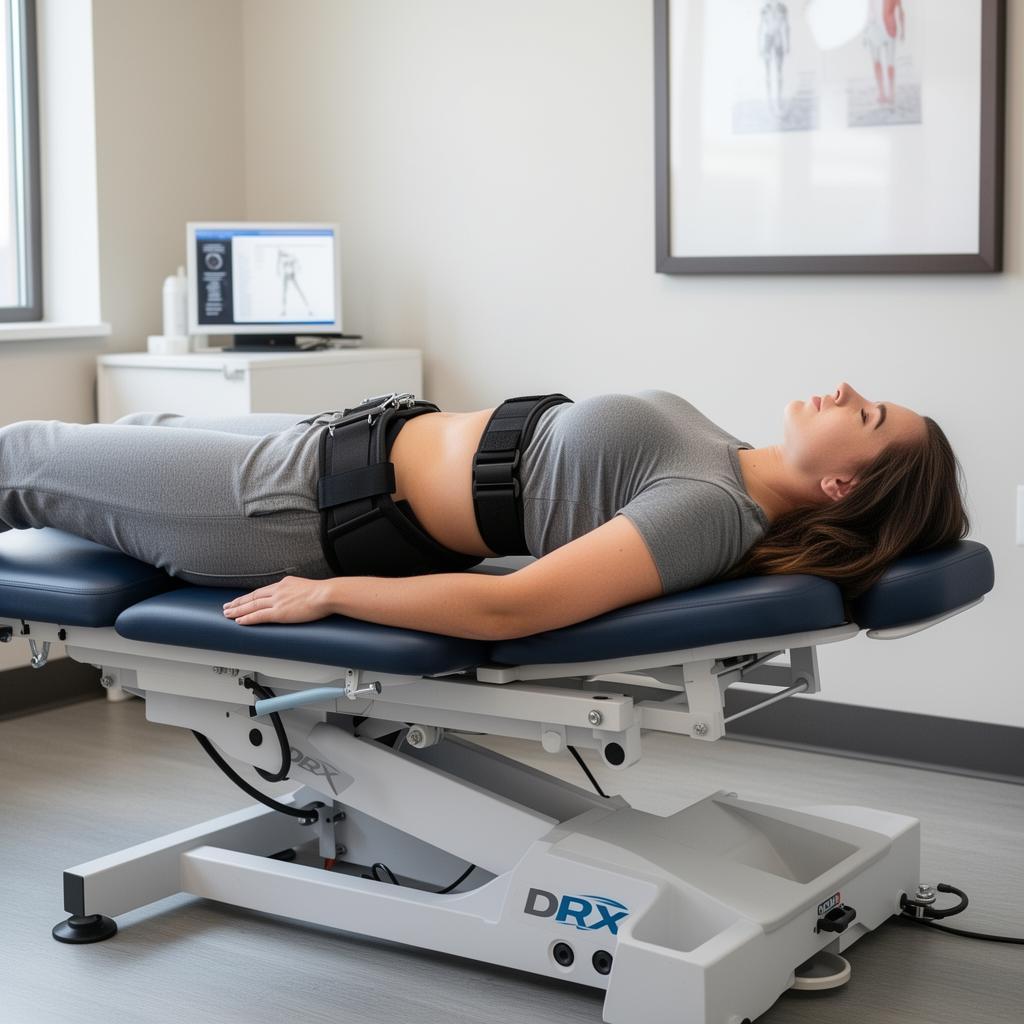
You lie on your back on the decompression table. A padded harness wraps your hips and is attached to the motorized portion of the table; your upper body stays stationary.
The table applies a slow stretch — typically 30 to 60 pounds depending on your size — for about a minute, then partially releases, then pulls again. The cycle repeats for 20 to 30 minutes. Most patients describe it as relaxing; some fall asleep.
Decompression vs the alternatives
- Epidural steroid injection: quick anti-inflammatory effect, no structural change, effect typically fades in weeks to months.
- Microdiscectomy surgery: effective for the right patient but invasive and best reserved for true surgical indications (progressive weakness, cauda equina, failed conservative care).
- Generic physical therapy: helpful but does not produce the intradiscal pressure changes a true decompression table does.
- Inversion tables at home: can offer mild traction but cannot reproduce the controlled, logarithmic pull of a clinical decompression table.
How we approach decompression at Pacific Spine & Rehab
Decompression is most successful when it is one part of a complete plan.
- Exam, neurological screen, and imaging review on visit one.
- Decompression sessions 2–3 times per week during the active phase.
- Chiropractic and soft-tissue work to address the segments above and below the injured disc.
- Core, hip, and posture rehab — the part that prevents recurrence.
- Tapered visits in the final weeks so you leave with a plan, not a dependency.
Frequently asked questions
How many spinal decompression sessions will I need?
Most lumbar disc cases need 18 to 24 sessions over 6 to 8 weeks. Mild cases resolve in 12; severe multi-level cases may need 30 or be referred for further imaging.
Is spinal decompression painful?
No. The traction is slow and gentle. Some patients are mildly sore after the first few sessions, similar to after a workout. Sharp pain during a session is not normal and should be reported immediately.
Will spinal decompression work for a herniated disc?
For most contained disc herniations, yes — studies and clinical experience both show high success rates. Large extruded or sequestered fragments respond less reliably; we identify those on the exam and imaging review.
Can decompression make a herniated disc worse?
Done properly on the right patient, no. Done on the wrong patient (acute fracture, severe osteoporosis, cancer in the spine, post-fusion hardware), it can cause harm — which is why a real exam and history come first.
Is spinal decompression covered by insurance?
Coverage varies. Some plans cover the chiropractic and rehab portions but not the table itself. We verify benefits and offer transparent self-pay packages. Personal-injury cases are treated on lien.
How is decompression different from a chiropractic adjustment?
An adjustment is a quick, specific movement of a vertebral joint. Decompression is a sustained, machine-controlled stretch designed to change pressure inside the disc itself. Most plans use both.
Pacific Spine & Rehab Clinical Team, DC, Chiropractic & Rehab
The Pacific Spine & Rehab clinical team practices in Oceanside and Carlsbad (Bressi Ranch). Our doctors of chiropractic combine manual care, spinal decompression, shockwave therapy, and rehab in one treatment plan — and treat auto-accident and injury patients on lien.
Related services
Related conditions
Same-day appointments
Talk to a doctor about your case
Get an exam, a diagnosis, and a written plan — two North County offices, treatment on lien for injury cases.