Treatment Guide
Chiropractic Adjustment in Oceanside: What to Expect
A chiropractic adjustment is the most common treatment patients ask about — and the least understood. Here is what actually happens during one, why joints pop, who benefits, what it costs in Oceanside, and when a different treatment is the better call.
Pacific Spine & Rehab Clinical Team, DC, Chiropractic & Rehab Published August 28, 2026 Updated August 28, 2026 12 min read
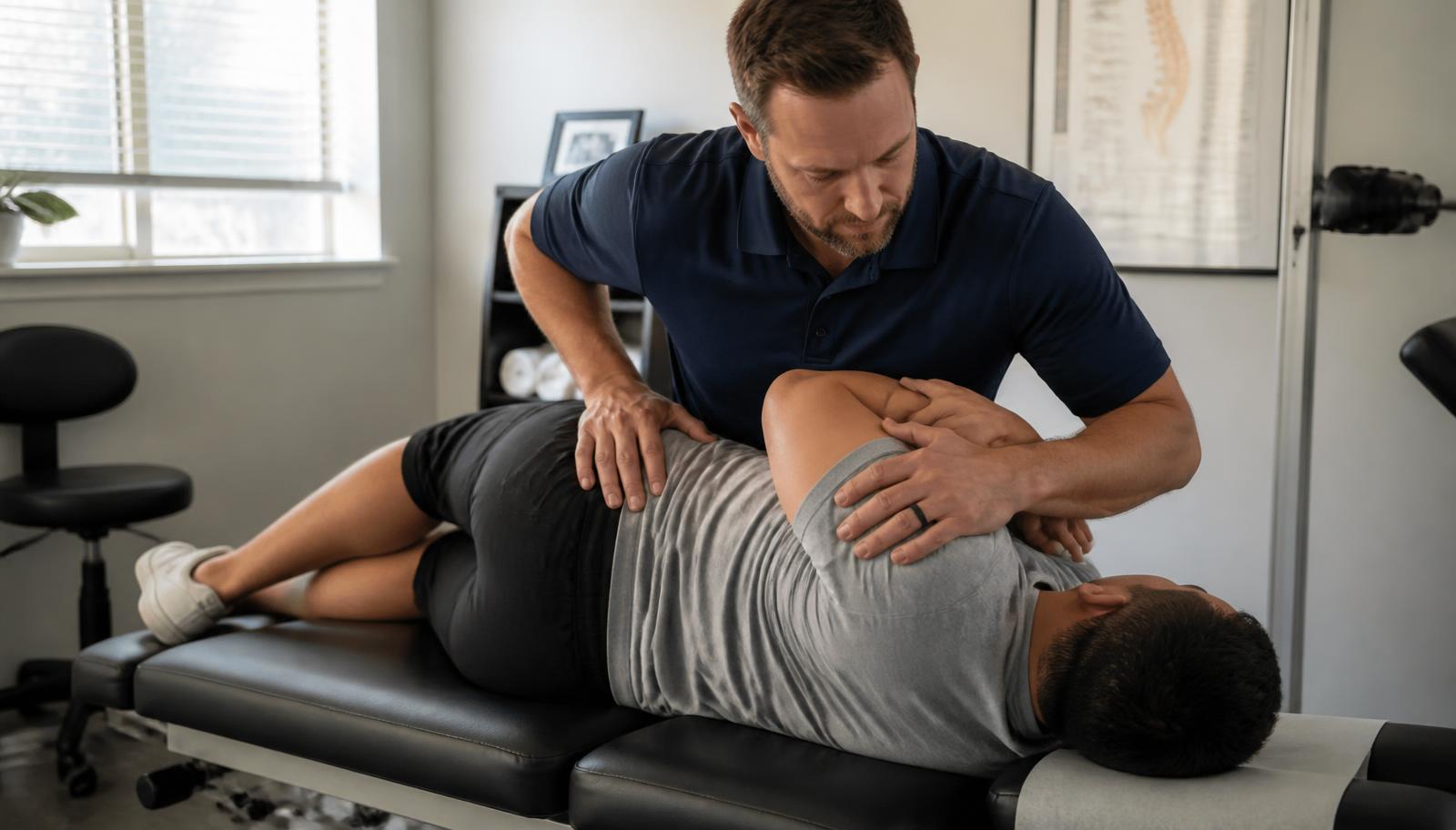
People book a chiropractic adjustment in Oceanside for a stiff neck after a workday, a back that locked up loading a surfboard, or a shoulder blade ache that will not release. The treatment itself is short and undramatic, which surprises most first-timers. Our Oceanside office performs dozens each day, and almost every new patient arrives with the same three questions: does it hurt, is it safe, and will it actually last.
This guide answers those directly. It explains what an adjustment does mechanically, what the popping sound is, who benefits most, how many visits a typical problem takes, what care costs locally, and the situations where an adjustment is the wrong first step.
Quick answer
A chiropractic adjustment in Oceanside is a quick, controlled movement applied to a restricted spinal or pelvic joint to restore normal motion and reduce pain. It usually takes seconds, rarely hurts, and most patients notice looser movement the same day. Typical relief for a new problem takes two to four visits.
Key takeaways
- An adjustment restores motion to a stuck joint — it does not put bones back in place.
- The pop is gas releasing inside the joint fluid, not bones cracking.
- Most patients feel looser immediately; lasting change needs strengthening too.
- Adjustments are low-risk when preceded by a proper exam and screening.
- A first visit with exam and adjustment runs about $49–$75 in Oceanside.
What is a chiropractic adjustment?
A chiropractic adjustment — clinically called spinal manipulation — is a controlled force applied to a specific joint that has lost its normal range of motion. The chiropractor positions the joint at the end of its available movement, then delivers a quick, shallow thrust that carries it slightly further.
The National Center for Complementary and Integrative Health describes spinal manipulation as a widely used approach for low back pain, delivered by trained practitioners using hands or a small instrument. The force is precise rather than forceful; depth is measured in millimeters.
Nothing is being put back in place. Vertebrae do not slip out of position and get shoved back. What changes is joint mobility: a segment that was moving poorly starts moving normally again, and the protective muscle tension around it settles.
The most common misconception
"My back is out" describes how it feels, not what happened. The joint is restricted and guarded, not displaced. That distinction matters, because restriction is treatable in minutes while displacement would be an emergency.
Why joints pop — and whether it matters
The audible pop is called cavitation. Joint surfaces are separated by fluid containing dissolved gases. When the joint is opened quickly, pressure inside drops and those gases form a bubble, producing the sound. It is the same phenomenon as cracking a knuckle.
The sound is not the treatment. A silent adjustment can restore motion perfectly well, and instrument-assisted and drop-table techniques often produce no noise at all. Patients who dislike the sensation can be treated entirely with those methods.
- The pop is gas release, not bone on bone.
- No sound does not mean the adjustment failed.
- The same joint cannot cavitate again for roughly 20 minutes.
- Frequent self-cracking is a sign of instability, not a fix.
What actually happens during your visit
A first appointment in Oceanside runs about 45 minutes. The adjustment itself is a small part of it.
- History. What hurts, when it started, what makes it better or worse, and your medical background.
- Exam. Range of motion, joint-by-joint palpation, orthopedic and neurological testing where the symptoms warrant it.
- Explanation. What the findings mean, in plain terms, before anything is done.
- Treatment. Soft-tissue work to relax guarding, then the adjustment to the specific restricted segments.
- Plan. A visit count, a review date, and two or three home movements to hold the change.
You should never be adjusted before being examined
The exam is what determines whether an adjustment is appropriate at all, which segments need it, and which technique is safe for your case. Any office that skips it is guessing.
Does a chiropractic adjustment hurt?
For most people, no. The thrust is fast enough that the nervous system registers pressure and release rather than pain. Patients commonly describe relief the moment the joint moves.
Some soreness afterward is normal, particularly after a first adjustment or when muscles have been guarding for weeks. It feels like post-workout soreness, lasts a day or two, and eases with movement, water, and heat.
| What you feel | What it usually means | Recommended next step |
|---|---|---|
| Immediate looseness and relief | Joint motion restored | Move normally; do the home exercises |
| Mild soreness for 24–48 hours | Muscles adapting to new motion | Heat, walking, hydration |
| Temporary fatigue after the visit | Nervous system settling out of guarding | Rest that evening, resume as usual |
| Sharp pain during the adjustment | Wrong technique or an unsuited joint | Tell the chiropractor immediately |
| New numbness, tingling, or weakness | Needs reassessment before further care | Stop treatment and get evaluated |
Problems that respond well to adjustments
Adjustments are best suited to mechanical problems — pain generated by joints and muscles rather than by disease.
- More on chiropractic care in Oceanside and on treatment for neck pain.
| Condition | Best for | Expected outcome |
|---|---|---|
| Acute locked low back | Sudden restriction with spasm | Fast relief, often within 1–3 visits |
| Neck stiffness and desk-posture pain | Restricted cervical segments | Improved rotation within a few visits |
| Tension headaches from the neck | Upper cervical joint restriction | Fewer, milder headaches over 3–6 weeks |
| Mid-back and rib pain | Thoracic restriction, catching breath | Immediate ease in most cases |
| Sacroiliac and hip-dimple pain | One-sided pelvic restriction | Relief plus glute strengthening needed |
| Sciatica with leg symptoms | Nerve irritation from joint or disc | Gradual change over 4–8 weeks, often with decompression |
Is it safe?
Spinal manipulation performed by a licensed chiropractor after an appropriate exam has a strong safety record. The National Institute of Neurological Disorders and Stroke lists manual therapy among conservative approaches used for back pain, ahead of invasive options. The most common side effect by a wide margin is short-lived soreness.
Safety depends on screening. Osteoporosis, inflammatory arthritis, recent fracture, anticoagulant use, a history of spinal surgery, or progressive neurological signs all change what technique is appropriate — or whether manipulation should be used at all. Those cases are treated with low-force instrument methods, mobilization, or referred out.
- Always disclose blood thinners, osteoporosis, and prior spinal surgery.
- Tell your chiropractor about any numbness, weakness, or dizziness.
- A good office adapts technique rather than applying one method to everyone.
How many adjustments will you need?
This is where practices differ most. A specific complaint should have a specific plan with a review point — not an open-ended schedule.
- Adjustments relieve; strengthening is what keeps the problem away. That is why most plans pair them with rehab therapy.
| Situation | First noticeable relief | Typical plan |
|---|---|---|
| Acute stiff neck or locked back | 1–2 visits | 4–6 visits over 2–3 weeks |
| Recurring pain over months or years | 2–4 visits | 12–18 visits over 8–12 weeks with rehab |
| Disc-related pain with leg symptoms | 2–5 visits | 8–12 weeks, often with decompression |
| Post-car-accident injury | 2–4 visits | 8–16 weeks, documented for the claim |
What a chiropractic adjustment costs in Oceanside
If you are paying out of pocket, the $49 new patient exam and first adjustment covers the full evaluation and treatment on the same visit.
| Situation | What you pay | Notes |
|---|---|---|
| New patient exam and adjustment | $49–$75 | Our new-patient special is $49 including first treatment |
| Follow-up adjustment, self-pay | $45–$75 | Lower with a prepaid package |
| With health insurance | Standard copay | Benefits verified before billing |
| Car accident injury | $0 up front | Treated on a lien, paid from the settlement |
| Work injury | $0 up front | Billed through workers' compensation |
When should you seek professional help?
Book an exam rather than waiting when pain is limiting what you do, and go to a physician first when the following appear.
- Loss of bladder or bowel control, or numbness around the groin.
- Progressive weakness in an arm or leg rather than pain alone.
- Severe pain following a high-speed collision or significant fall.
- Fever, unexplained weight loss, or a cancer history with new spinal pain.
- Sudden severe headache with dizziness, visual change, or slurred speech.
Booking an adjustment in Oceanside
- Call or book online — same-day openings are held for acute pain.
- Bring your insurance card and any accident or imaging paperwork.
- Allow about 45 minutes for the first visit.
- Expect an exam and an explanation before any adjustment.
- Leave with a written plan, a review date, and a short home program.
Frequently asked questions
What is a chiropractic adjustment and how does it work?
A chiropractic adjustment is a controlled, shallow thrust applied to a joint that has lost normal motion, usually in the spine or pelvis. The chiropractor positions the joint at the end of its available range and moves it slightly beyond, which restores gliding motion between the joint surfaces and reduces the protective muscle tension surrounding it. Nothing is put back in place; vertebrae do not slip out of alignment. The mechanical input also calms the pain signaling from that segment, which is why many patients feel relief within seconds of the adjustment.
Does a chiropractic adjustment hurt?
Most people find it painless. The thrust is fast and shallow, so the sensation is pressure followed by release rather than pain, and many patients report immediate relief. Mild soreness in the following 24 to 48 hours is common after a first adjustment or when muscles have been guarding for weeks — it feels like post-exercise soreness and eases with walking, heat, and hydration. Sharp pain during the adjustment is not normal; say so immediately, because it usually means the technique or position needs to change.
What is the popping sound during an adjustment?
The sound is cavitation: gases dissolved in the joint fluid form a bubble when pressure inside the joint drops suddenly, exactly as happens when you crack a knuckle. Bones are not grinding or snapping. The sound is not the goal either — instrument-assisted, drop-table, and mobilization techniques restore joint motion with no noise at all, and they work just as well. If the sound bothers you, ask for a low-force technique; a good Oceanside office will adapt without argument.
How many chiropractic adjustments will I need?
It depends on how long the problem has existed. An acute stiff neck or locked back often resolves in four to six visits across two to three weeks. Pain that has recurred for months or years typically takes twelve to eighteen visits over eight to twelve weeks, because the strengthening phase matters as much as the hands-on work. Disc-related pain with leg symptoms usually runs eight to twelve weeks. Whatever the plan, it should include a review point around visit six with measurable change in pain, motion, or function.
Are chiropractic adjustments safe?
For most people, yes. Performed by a licensed chiropractor after a proper exam, spinal manipulation has a strong safety record, and the most frequent side effect is temporary soreness. Safety depends on screening: osteoporosis, inflammatory arthritis, recent fracture, blood-thinning medication, prior spinal surgery, or progressive neurological signs all change which technique is appropriate or rule manipulation out entirely. Those patients are treated with low-force instrument methods or referred for medical evaluation. Always disclose your full medical history at the first visit.
Can I get a same-day chiropractic adjustment in Oceanside?
Yes. We reserve same-day openings at the Oceanside office each day for acute problems — a back that locked up this morning, a neck that will not turn, a flare-up after a workout or a collision. Early treatment usually shortens the whole episode, because interrupting the muscle-guarding phase quickly keeps it from compounding. Call in the morning for the widest choice of times, and bring your insurance card. If the exam suggests something outside chiropractic scope, we will tell you directly and refer you out.
Do I have to keep going to a chiropractor forever?
No. A specific complaint gets a specific plan with an end point. Once pain resolves and motion is restored, the work shifts to a short home program that maintains the change, and most patients return only if something flares. Some people choose periodic maintenance visits because their work or sport keeps reloading the same area, but that should be a choice, not a requirement. If an office cannot tell you how many visits your plan involves and when it will be reviewed, ask again until they do.
Same-day appointments
Talk to a doctor about your case
Get an exam, a diagnosis, and a written plan — two North County offices, treatment on lien for injury cases.
PS
Medically reviewed by
Pacific Spine & Rehab Clinical Team, DC, Chiropractic & Rehab
The Pacific Spine & Rehab clinical team practices in Oceanside and Carlsbad (Bressi Ranch). Our doctors of chiropractic combine manual care, spinal decompression, shockwave therapy, and rehab in one treatment plan — and treat auto-accident and injury patients on lien.
Related services
Related conditions
Related articles