Treatment Guide
Chiropractic Rehab in Carlsbad: How to Stop Pain From Coming Back
Adjustments restore motion. Rehab is what keeps it. Here is how chiropractic rehab works at our Carlsbad (Bressi Ranch) office — the phases, the exercises, realistic timelines, costs, and how to tell whether a plan is working.
Pacific Spine & Rehab Clinical Team, DC, Chiropractic & Rehab Published August 17, 2026 Updated August 17, 2026 11 min read
Most people searching for chiropractic rehab in Carlsbad have already lived the cycle: the adjustment helped, the pain left for a week or two, then a long commute down El Camino Real or one heavy lift brought it straight back. That is not a failed adjustment. It is what happens when a joint regains motion but nothing rebuilds the muscle control around it. Rehab therapy at our Bressi Ranch office exists to close that gap.
This guide covers what chiropractic rehab includes, the three phases of a plan and how long each takes, the exercises used at each stage, how progress gets measured, what care costs locally, how insurance and injury claims work, and the signals that a plan needs to change.
Quick answer
Chiropractic rehab in Carlsbad pairs spinal adjustments with corrective exercise, soft-tissue work, and movement retraining so relief holds. The adjustment restores joint motion; rehab rebuilds the strength and control that keep it. Most plans run six to twelve weeks through pain relief, stabilization, and strengthening phases.
Key takeaways
- Adjustments restore motion; rehab builds the control that keeps it.
- Plans run in three phases — calm the pain, stabilize the joint, then load it.
- Skipping the strengthening phase is the most common cause of relapse.
- A 10–15 minute daily home program matters more than extra office visits.
- Progress is judged by function — sitting, lifting, sleeping — not pain scores alone.
What chiropractic rehab in Carlsbad involves
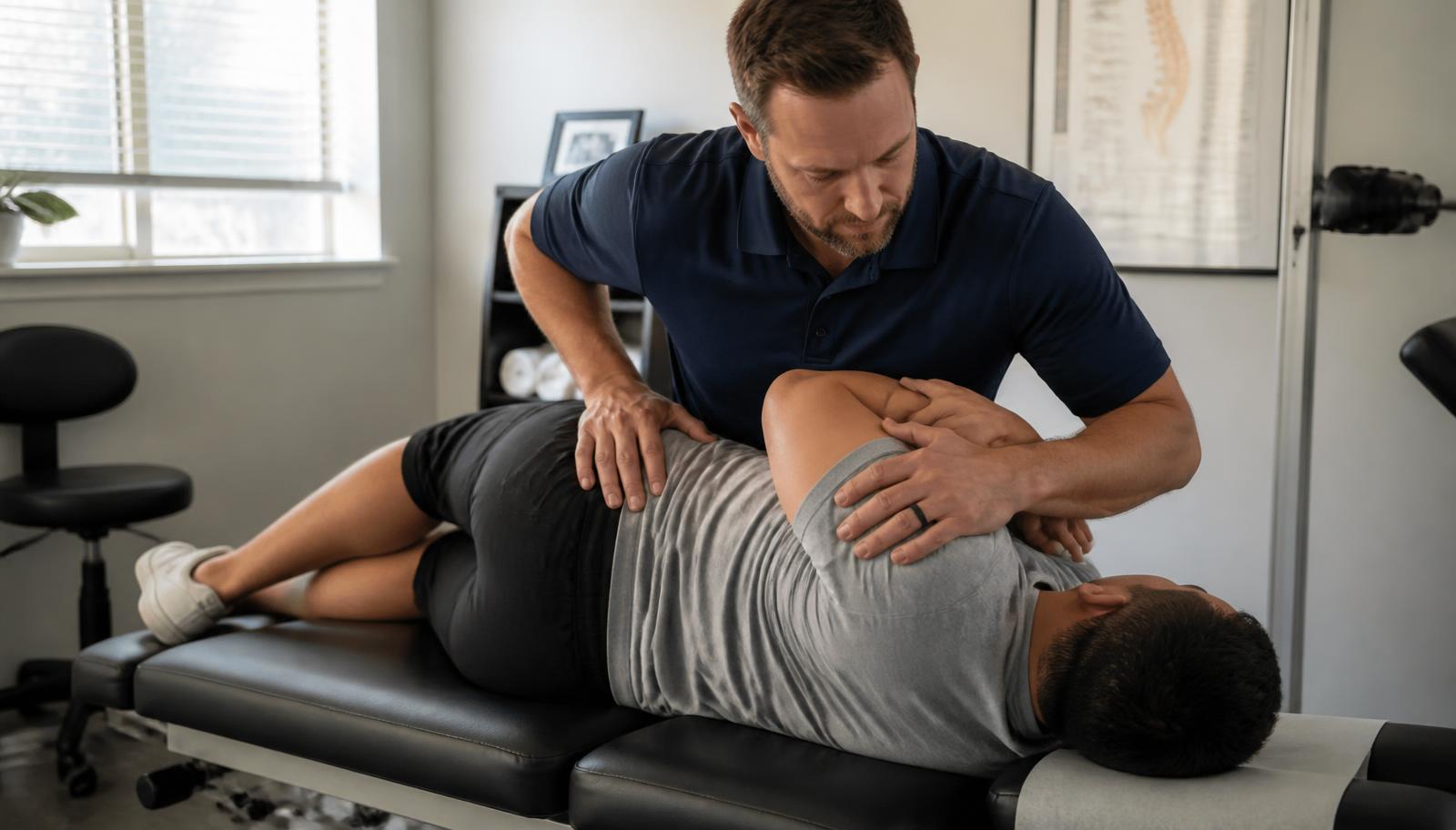
Chiropractic rehab is hands-on care and prescribed exercise inside one treatment plan. The chiropractic side restores joint motion and lowers pain. The rehab side retrains the muscles, timing, and movement patterns that let the joint hold that position under real load — carrying groceries, sitting through a commute, surfing at Ponto.
Exercise therapy is a core part of conservative care for chronic low-back pain, and the National Institute of Neurological Disorders and Stroke notes that staying active and strengthening supporting muscles improves long-term outcomes more than rest.
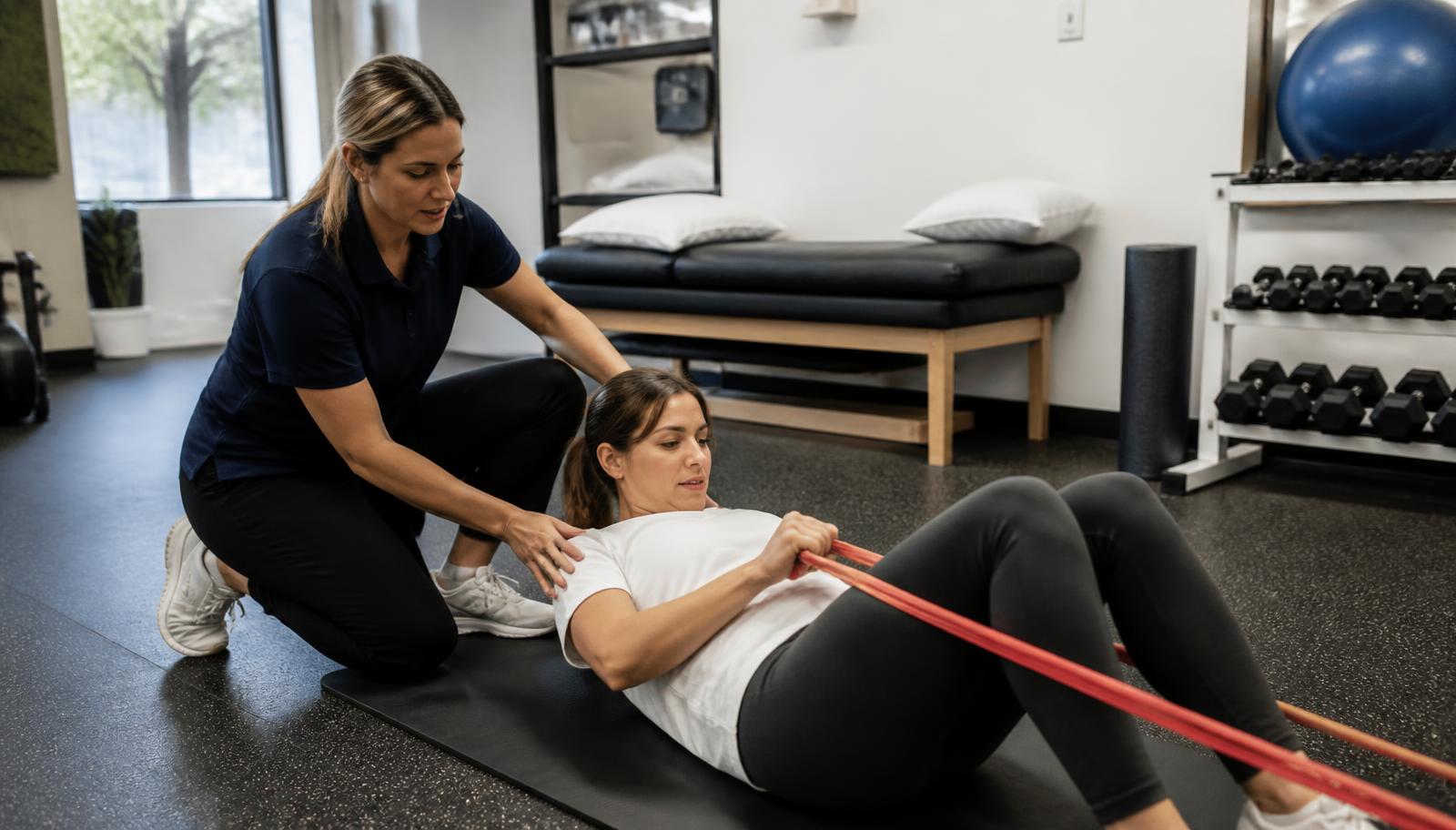
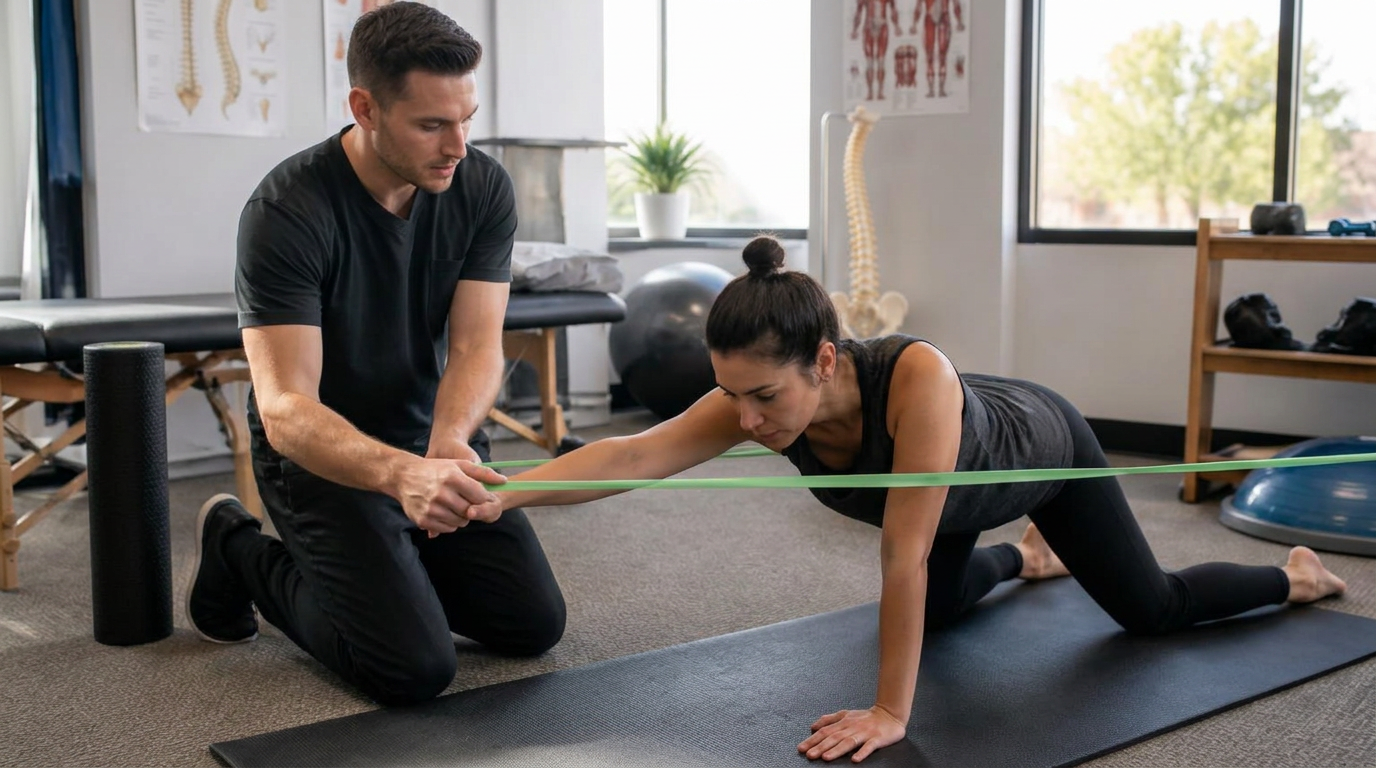
A rehab visit looks different from a straight adjustment visit. Part of the appointment happens on the table and part on a mat or at a rack, coached through deliberately unglamorous movements: hip hinges, dead bugs, banded rows, single-leg balance. The goal is control, not intensity.
Rehab is not general exercise
A gym program builds on strength you already have. Rehab restores movement you have lost — which is why the first exercises look almost too easy. Loading a joint that cannot yet control itself is how people re-injure.
Why adjustments alone tend to relapse
When a joint hurts, the muscles around it guard. Guarding shuts down the deep stabilizers that hold a segment steady, and larger muscles take over the job badly. An adjustment releases the restriction, but the faulty pattern is still there the moment you stand up and walk out.
That is why hands-on care alone often buys days rather than months. The table below compares the two approaches for the conditions we treat most.
- Relapse within two to four weeks of finishing care usually means the strengthening phase was skipped.
- Pain returning in a new area often means a compensation pattern was never addressed.
- Needing an adjustment every week indefinitely signals an incomplete plan, not a need for more visits.
| Approach | What it does well | Where it falls short |
|---|---|---|
| Adjustments only | Fast pain relief, restored joint motion | Relief fades once normal loading resumes |
| Exercise only | Builds strength over time | Slow when a joint is restricted or acutely painful |
| Chiropractic rehab | Restores motion, then trains the body to keep it | Requires daily home work and 6–12 weeks of consistency |
Conditions chiropractic rehab helps most
Rehab adds the most where a problem is recurring, load-related, or post-injury — anywhere tissue has healed but movement has not normalized.
- Related conditions: lower back pain, sciatica, neck pain, and sports injuries.
| Condition | What rehab targets | Typical plan length |
|---|---|---|
| Recurring lower back pain | Hip mobility, core control, safe hinge pattern | 8–12 weeks |
| Neck pain and desk posture | Deep neck flexors, scapular control, workstation setup | 6–10 weeks |
| Sciatica | Nerve glides, glute strength, sitting tolerance | 6–12 weeks |
| Whiplash after a crash | Graded range of motion, then endurance work | 8–16 weeks |
| Shoulder pain | Rotator cuff endurance, thoracic mobility | 8–12 weeks |
| Sports injuries | Return-to-activity progression and load tolerance | 6–12 weeks |
The three phases of a rehab plan
Each phase has an exit criterion rather than a fixed date — you advance when you can perform the phase's movements well. Our corrective exercise program covers the progressions used in phases two and three.
- Phase 1 — Calm it down (weeks 1–2). Adjustments, soft-tissue work, and gentle motion. Home work is two or three easy movements plus walking. Goal: sleep through the night and move without bracing.
- Phase 2 — Stabilize (weeks 3–6). Deep core and postural control work, balance drills, and position-specific exercise. Adjustment frequency drops. Goal: sit, drive, and stand normally without symptoms.
- Phase 3 — Strengthen and load (weeks 6–12). Progressive resistance, hinge and squat patterns, carries, and job- or sport-specific movement. Goal: full activity plus a maintenance routine you will actually keep.
The home program is the plan
Ten to fifteen minutes daily at home outperforms an extra weekly office visit. Patients who stay consistent finish faster and relapse far less often.
How progress is measured
Pain alone is a poor metric — it swings with sleep, stress, and workload. A rehab plan should track function alongside it, and you should be told the numbers.
- Reviews should happen roughly every four to six visits.
- If two measures have not moved by visit six, the plan should change — different technique, imaging, or referral.
- Function gains with flat pain scores are still progress; pain often lags function by weeks.
| Measure | How it is tested | What improvement looks like |
|---|---|---|
| Range of motion | Degrees of bend, rotation, or reach | Steady gains week over week |
| Pain with activity | 0–10 scale during a specific task | Lower score at the same or higher load |
| Endurance | Timed plank, bridge, or balance hold | Longer holds with good form |
| Daily function | Sitting, driving, lifting, sleeping tolerance | Fewer restrictions in normal life |
Cost, insurance, and injury claims in Carlsbad
New patients start with a $49 exam and first treatment at either North County office, detailed on our new patient special offers page. From there you get a written plan stating visit count and the review point before care continues.
Most health plans cover chiropractic and rehab visits with a copay, and we verify benefits before billing. Car-accident patients are treated on a lien in California, so rehab starts immediately and is paid from the settlement. Work injuries bill through workers' compensation once a claim number is issued.
Chiropractors in California are licensed by the California Board of Chiropractic Examiners, and rehabilitative exercise falls within that scope of practice.
When to seek professional help — and when rehab is not the answer
Self-directed stretching is fine for ordinary stiffness. Book an exam when pain keeps returning, limits activity, or has lasted more than two weeks, because recurring pain is a pattern problem and patterns need to be assessed rather than guessed at.
Some symptoms require medical evaluation before any rehab begins. The National Center for Complementary and Integrative Health advises consulting a physician when back pain comes with neurological symptoms.
- Numbness in both legs, saddle numbness, or new bladder or bowel changes — emergency care.
- Progressive weakness in an arm or leg rather than pain alone.
- Fever, unexplained weight loss, or night pain with back symptoms.
- Pain after a significant fall or high-speed collision.
- A history of cancer or osteoporosis with new spinal pain.
Getting started with rehab in Carlsbad
Not sure rehab is the right next step? Send us a message with your symptoms and a doctor will tell you honestly whether this is our problem to solve or one for a physician.
- Book an exam — same-day openings are held daily for new and flaring cases.
- Bring any imaging, incident reports, or prior treatment notes.
- Expect a movement assessment, not just a pain interview.
- Leave with a written plan: phase, visit count, review point, home exercises.
- Do the home program daily and report what changes between visits.
Frequently asked questions
What is chiropractic rehab and how is it different from regular chiropractic?
Regular chiropractic care focuses on hands-on treatment: adjustments, soft-tissue therapy, and modalities that restore joint motion and reduce pain. Chiropractic rehab adds prescribed corrective exercise and movement retraining to that same plan. The adjustment gives the joint its motion back; the rehab teaches the surrounding muscles to hold it under real-world load. A rehab appointment splits time between the treatment table and a mat or rack, and you leave with a short daily home program. That combination is what stops pain from cycling back every few weeks.
How long does a chiropractic rehab plan take in Carlsbad?
Most plans run six to twelve weeks across three phases. The first one to two weeks calm the pain with hands-on care and gentle movement. Weeks three to six build stability and control. Weeks six to twelve add progressive strength and return you to full activity. Simple, recent problems can finish in six weeks. Post-accident injuries, long-standing recurring pain, and disc-related cases often run twelve to sixteen. Each phase has an exit criterion based on what you can do, so you advance on function rather than on the calendar.
Do I have to do exercises at home?
Yes, and it is the part that decides the outcome. The home program is usually ten to fifteen minutes a day, two to four movements at a time, and it matters more than adding office visits. Exercises are chosen so you can do them without equipment in a small space. Patients who complete the home program consistently finish their plans faster, need fewer total visits, and relapse far less often than those relying on in-office treatment alone.
Will rehab exercises make my pain worse?
Correctly prescribed rehab should not increase pain beyond mild muscle fatigue or next-day soreness. Early-phase exercises are deliberately low-load for that reason — a joint that cannot yet stabilize itself is not ready for resistance. If an exercise reproduces sharp pain, causes numbness or tingling, or leaves you worse the following day, stop it and tell the office. That feedback changes the prescription. Pain that spikes rather than gradually settles is information, not something to push through.
Does insurance cover chiropractic rehab in Carlsbad?
Most major health plans cover chiropractic and rehabilitative exercise visits with a copay, and we verify your benefits before any billing so there are no surprises. New patients without coverage start with a $49 exam and first treatment. If your injury came from a car accident, California allows treatment on a lien — care starts right away and is paid from the settlement rather than out of pocket. Work injuries bill to workers' compensation once a claim number exists.
How do I know whether my rehab plan is working?
Look at function, not only pain. By the fourth to sixth visit you should see measurable change in at least two areas: range of motion, how long you can sit or stand comfortably, endurance holds, or the specific activity that brought you in. Pain scores often lag function by a couple of weeks, so improved movement with unchanged pain is still progress. If nothing has moved by visit six, the plan should change — a different technique, imaging, or a referral, not simply more of the same.
Can I keep training during chiropractic rehab?
Usually yes, with modifications. We would rather adjust your training than stop it, because deconditioning slows recovery. That typically means pausing the specific loaded movements that aggravate the injured area — heavy deadlifts for an acute low back, overhead pressing for an irritated shoulder — while keeping cardiovascular work, walking, and unaffected lifts. As you move through the stabilization and strengthening phases, those movements come back deliberately, often with better technique than before the injury.
Same-day appointments
Talk to a doctor about your case
Get an exam, a diagnosis, and a written plan — two North County offices, treatment on lien for injury cases.
PS
Medically reviewed by
Pacific Spine & Rehab Clinical Team, DC, Chiropractic & Rehab
The Pacific Spine & Rehab clinical team practices in Oceanside and Carlsbad (Bressi Ranch). Our doctors of chiropractic combine manual care, spinal decompression, shockwave therapy, and rehab in one treatment plan — and treat auto-accident and injury patients on lien.
Related services
Related conditions
Related articles