Local Care Guide
Chiropractic Care in Oceanside, CA: What It Treats and How It Works
What chiropractic care in Oceanside, CA actually involves — the conditions it helps, how a treatment plan is built, realistic recovery timelines, what it costs locally, and the warning signs that call for medical care instead.
Pacific Spine & Rehab Clinical Team, DC, Chiropractic & Rehab Published August 3, 2026 Updated August 3, 2026 11 min read
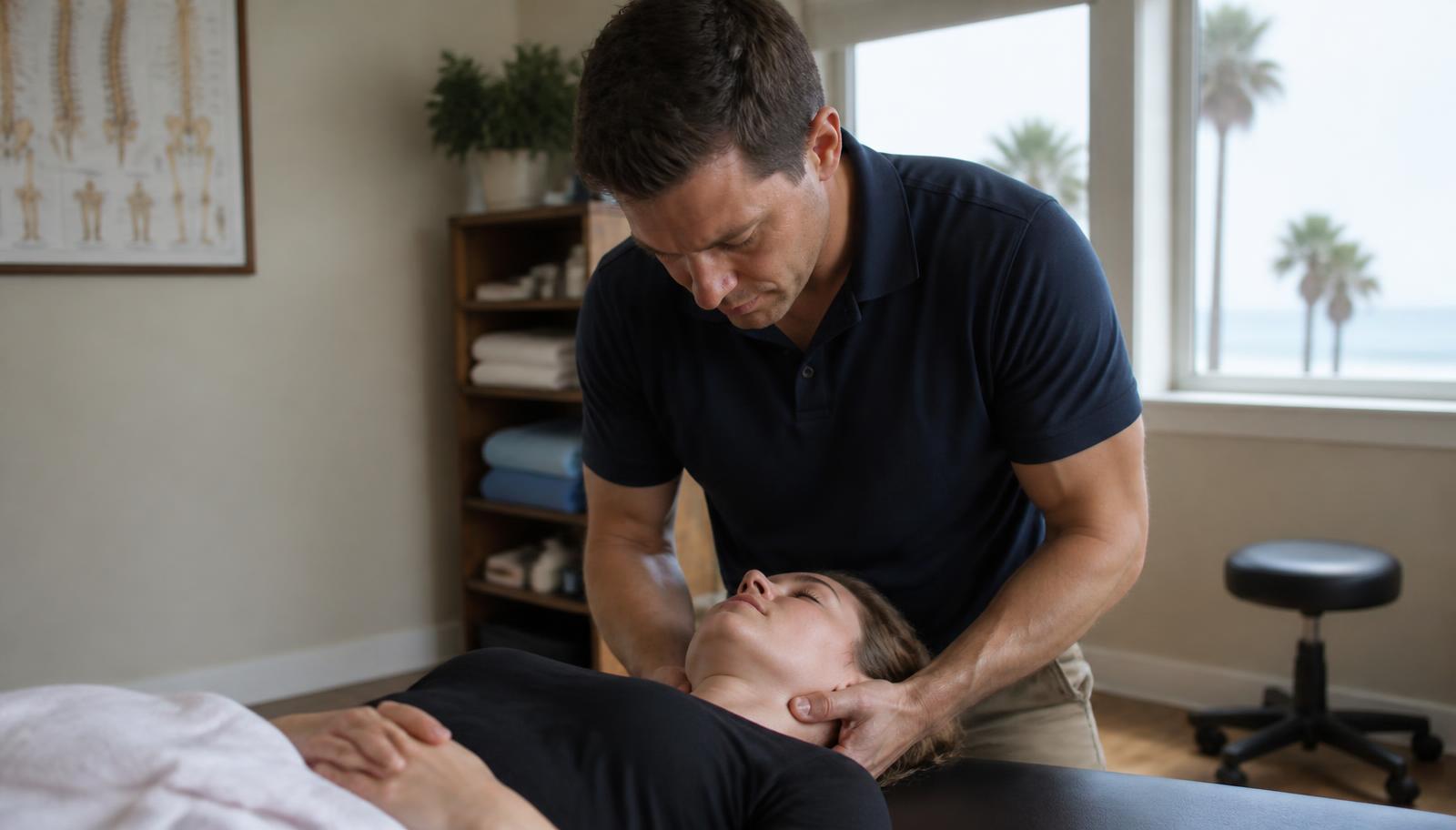
Most people book chiropractic care in Oceanside, CA after weeks of hoping the pain would fade on its own. It rarely does, because the joints, discs, and muscles around a painful area keep compensating until movement itself becomes the problem. Chiropractic care at our North County offices starts by identifying which tissue is actually driving the pain, then treating that.
This guide walks through what chiropractic care covers, what happens at each stage of a plan, how long relief realistically takes, what it costs locally, how insurance and injury claims are handled, and the symptoms that should send you to a physician instead of a treatment table.
Quick answer
Chiropractic care in Oceanside, CA treats back pain, neck pain, sciatica, headaches, joint pain, and auto-accident injuries without drugs or surgery. Treatment combines spinal adjustments, soft-tissue therapy, and corrective exercise. Most patients feel measurable improvement within two to six visits and finish an initial plan in four to eight weeks.
Key takeaways
- Chiropractic care is a diagnosis-first process: exam, working diagnosis, then a written plan with an end date.
- Adjustments work best paired with rehab exercise — hands-on care alone tends to relapse.
- Expect a measurable change by visit four to six; if nothing has moved, the plan should change.
- Auto-accident injuries can be treated on lien in California, so care starts before a claim settles.
- Numbness in both legs, bladder changes, unexplained weight loss, or fever with back pain mean urgent medical evaluation first.
What chiropractic care in Oceanside, CA involves
Chiropractic care is the diagnosis and conservative treatment of musculoskeletal problems — the spine most often, but also shoulders, hips, knees, feet, and the jaw. A doctor of chiropractic (DC) uses hands-on joint manipulation, soft-tissue therapy, traction or decompression, and prescribed exercise to restore normal movement and reduce pain.
Spinal manipulation is supported by research for low-back pain, neck pain, and certain headache types, according to the National Center for Complementary and Integrative Health. It is drug-free and non-surgical, which makes it a reasonable first step for mechanical pain and a poor substitute for medical care when a condition is systemic or structural.
In Oceanside the patient mix is distinct: Camp Pendleton families with load-bearing and training injuries, desk workers with neck and upper-back strain, surfers and runners with shoulder and foot problems, and drivers hurt on the 5, the 78, or Coast Highway who need documented injury care.
Care is a plan, not a subscription
A legitimate plan has a stated goal, a visit count, and a review point. If a clinic quotes a year of visits before examining you, that is a sales structure — not a diagnosis.
Conditions chiropractic care treats well
Chiropractic care is most effective for mechanical pain — pain that changes with position, movement, or load. The table below shows what we treat most often in Oceanside and what a typical response looks like.
- Persistent lower back pain and disc-related pain
- Sciatica and nerve pain traveling into the leg
- Whiplash and other auto-accident injuries
- Recurring headaches and migraines
- Sports and repetitive-strain injuries in active adults
| Condition | Best for | Typical response |
|---|---|---|
| Lower back pain | Stiffness and pain that worsens with sitting or lifting | Noticeable relief in 2–4 visits; plan of 6–10 |
| Neck pain and tech neck | Desk workers, limited head rotation | Range of motion improves quickly; 4–8 visits |
| Sciatica | Leg pain from a pinched or irritated nerve | Leg symptoms recede toward the back over 3–6 weeks |
| Tension headaches | Pain starting at the base of the skull | Frequency drops within 2–3 weeks |
| Whiplash / auto injury | Neck and back pain after a collision | 6–12 weeks of documented care is common |
| Shoulder, knee, foot pain | Tendon overload and joint restriction | Often paired with shockwave therapy |
Signs it is time to start care
The most common mistake is waiting until pain limits work or sleep. By then the surrounding muscles have already adapted, which is why a two-week problem can turn into a three-month one.
- Back or neck pain lasting longer than a week, or returning every few months
- Pain that radiates into a buttock, leg, shoulder, or arm
- Morning stiffness that takes 20 minutes or more to loosen
- Reduced motion — you cannot check a blind spot or reach overhead comfortably
- Numbness or tingling in one limb
- Any lingering symptom after a collision, fall, or heavy lift
Causes and risk factors we see locally
Most spine pain is cumulative rather than traumatic. The National Institute of Neurological Disorders and Stroke notes that most low-back pain is mechanical and resolves with conservative care, though repeated strain and poor conditioning make recurrence likely.
Locally the drivers are predictable: long commutes on the 5, desk work without a movement break, weekend surfing or lifting after a sedentary week, and physically demanding military training schedules.
- Prolonged sitting and unsupported laptop posture
- Sudden increases in training volume
- Repetitive lifting with poor hip mechanics
- Previous injury that never fully rehabbed
- Sleep position and mattress support
What happens during a course of care
Chiropractic care runs in phases. Knowing the sequence makes it obvious whether a plan is progressing or stalling.
- Visit one — history, orthopedic and neurological exam, imaging referral if indicated, and a working diagnosis. No adjustment until the exam is done.
- Visits two through four — pain control: adjustments, soft-tissue work, decompression or shockwave where appropriate.
- Visits four through eight — stability: corrective exercise added so gains hold between appointments.
- Review point — objective re-check of range of motion, pain scores, and function. The plan continues, changes, or ends here.
- Maintenance or discharge — a home program, and periodic visits only if your history warrants it.
The rehab half matters most
Adjustments restore motion; exercise keeps it. Our rehab therapy and corrective exercise programs exist so patients stop cycling back with the same complaint every spring.
Cost, insurance, and injury claims in Oceanside
Pricing should be plain before treatment starts. Below is how payment usually works at North County clinics, including ours.
- Our $49 new patient special covers the exam and consultation.
- First-party (MedPay) and third-party personal injury claims are both accepted.
- Lien care means treatment starts now and is billed when the claim resolves.
| Payment path | Best for | What to ask |
|---|---|---|
| New patient special | First-time patients testing fit | What the exam includes and what follow-ups cost |
| Health insurance | Plans with chiropractic benefits | Visit limits, copay, deductible status |
| Cash / self-pay | No coverage or out-of-network | Per-visit rate and prepaid package terms |
| Auto insurance (MedPay) | Recent collision | MedPay limit on your own policy |
| Treatment on lien | Injury claim not yet settled | Whether the clinic bills the settlement directly |
When to see a physician instead
Chiropractic care is appropriate for mechanical pain. Certain symptoms indicate something else and require urgent medical evaluation before any manual treatment.
- Numbness or weakness in both legs
- Loss of bladder or bowel control
- Fever alongside back pain
- Unexplained weight loss with persistent pain
- Severe pain after major trauma, before imaging
- A history of cancer with new spine pain
We will tell you when it is not us
If your exam points to something outside conservative care, we refer out the same day. You can reach either office through our contact page.
How to choose a chiropractic clinic
- Verify the California license — the state board publishes a free lookup.
- Ask for a written plan with a visit count and review date.
- Confirm rehab is part of care, not an upsell.
- Ask how auto-accident documentation is handled if you were in a collision.
- Check that pricing is given before treatment, in writing.
Frequently asked questions
How much does chiropractic care in Oceanside, CA cost?
Most Oceanside clinics charge between $50 and $85 per follow-up visit for self-pay patients, with the initial exam priced separately. Our new patient special is $49 and includes the consultation and exam. If you have health insurance with chiropractic benefits, your cost is a copay set by your plan. After a car accident, care can be billed to MedPay on your own auto policy or provided on lien and billed when the claim settles, so there is no upfront cost.
How many visits will I need?
Most patients with straightforward back or neck pain complete an initial plan in six to ten visits over four to eight weeks. Longstanding problems, disc-related pain, and auto-accident injuries often need eight to twenty visits with documentation. You should see measurable change — less pain, better range of motion, easier sleep — by visit four to six. If nothing has changed by then, the plan needs adjusting or a referral, not more of the same.
Does a chiropractic adjustment hurt?
An adjustment is usually painless. You may hear a pop, which is gas releasing from the joint capsule, not bones cracking. Patients with acute muscle spasm sometimes feel brief discomfort during the setup rather than the adjustment itself. Mild soreness for a day afterward, similar to post-workout soreness, is common at the start of care and fades as the surrounding muscles adapt. Gentler instrument-assisted techniques are available for patients who prefer no manual thrust.
Is chiropractic care safe?
For mechanical spine pain, chiropractic care has a strong safety record. The most common side effect is temporary soreness. Serious complications are rare and are largely avoided by a proper history and exam, which is why any first visit should include screening before treatment. Patients with osteoporosis, inflammatory arthritis, blood-thinning medication, or recent fractures need modified techniques, so disclose your full medical history before care begins.
Do I need a referral to see a chiropractor in California?
No. California allows direct access, so you can book chiropractic care without a physician referral. Some health plans, HMOs in particular, still require a referral for the visit to be covered, so check your benefits if you plan to use insurance. Auto-accident and workers' compensation claims have their own authorization rules, and our front office verifies those before your first appointment so billing is not a surprise.
Can chiropractic care help after a car accident?
Yes. Whiplash, neck strain, low-back pain, and headaches are among the most common post-collision complaints, and they respond well to conservative care started early. Timely treatment also creates the medical documentation an injury claim depends on. California allows treatment on lien, so you can begin care immediately and have it billed from the settlement rather than paying out of pocket while the claim is open.
How soon will I feel better?
Many patients notice reduced pain or easier movement within the first two visits, particularly with acute muscle-guarding. Sciatica and disc-related pain generally take three to six weeks to change meaningfully, as the leg symptoms retreat toward the back before disappearing. Long-term results depend on the exercise portion of your plan — patients who complete the home program relapse far less often than those who stop as soon as the pain fades.
Same-day appointments
Talk to a doctor about your case
Get an exam, a diagnosis, and a written plan — two North County offices, treatment on lien for injury cases.
PS
Medically reviewed by
Pacific Spine & Rehab Clinical Team, DC, Chiropractic & Rehab
The Pacific Spine & Rehab clinical team practices in Oceanside and Carlsbad (Bressi Ranch). Our doctors of chiropractic combine manual care, spinal decompression, shockwave therapy, and rehab in one treatment plan — and treat auto-accident and injury patients on lien.
Related services
Related conditions
Related articles